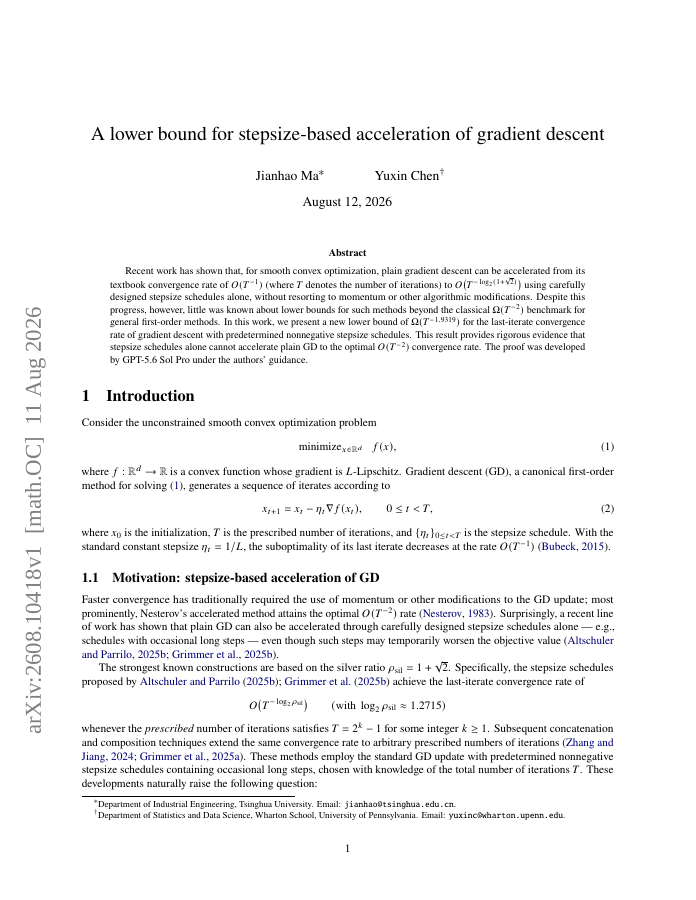
Recent work has shown that, for smooth convex optimization, plain gradient descent can be accelerated from its textbook convergence rate of O(T^{-1}) (where T denotes the number of iterations) to O\big(T^{-\log_2(1+\sqrt{2})}\big) using carefully designed stepsize schedules alone, without resorting to momentum or other algorithmic modifications. Despite this progress, however, little was known about lower bounds for such methods beyond the classical Ω(T^{-2}) benchmark for general first-order methods. In this work, we present a new lower bound of Ω(T^{-1.9319}) for the last-iterate convergence rate of gradient descent with predetermined nonnegative stepsize schedules. This result provides rigorous evidence that stepsize schedules alone cannot accelerate plain GD to the optimal O(T^{-2}) convergence rate. The proof was developed by GPT-5.6 Sol Pro under the authors' guidance.
A lower bound for stepsize-based acceleration of gradient descent
Recent work has shown that, for smooth convex optimization, plain gradient descent can be accelerated from its textbook convergence rate of $O(T^{-1})$ (where $T$ denotes the number of iterations) to $O\big(T^{-\log_2(1+\sqrt{2})}\big)$ using carefully designed stepsize…
- Preview
- Year
- 2026
- Hosting
- Abstract onlyARXIV-DEFAULT
Cite
Notes
Only stored in your browser.
Attribution
- Abstract & full text
- arxiv.org/abs/2608.10418ARXIV-DEFAULT
- TL;DR
- Semantic Scholar