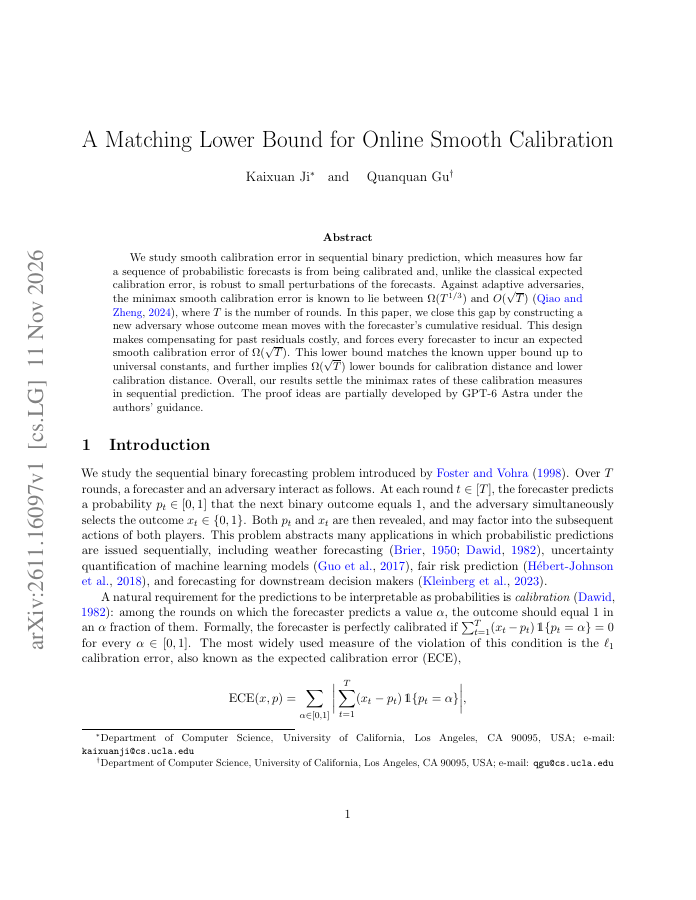
We study smooth calibration error in sequential binary prediction, which measures how far a sequence of probabilistic forecasts is from being calibrated and, unlike the classical expected calibration error, is robust to small perturbations of the forecasts. Against adaptive adversaries, the minimax smooth calibration error is known to lie between Ω(T^{1/3}) and O(\sqrt{T}) (Qiao and Zheng, 2024), where T is the number of rounds. In this paper, we close this gap by constructing a new adversary whose outcome mean moves with the forecaster's cumulative residual. This design makes compensating for past residuals costly, and forces every forecaster to incur an expected smooth calibration error of Ω(\sqrt{T}). This lower bound matches the known upper bound up to universal constants, and further implies Ω(\sqrt{T}) lower bounds for calibration distance and lower calibration distance. Overall, our results settle the minimax rates of these calibration measures in sequential prediction. The proof ideas are partially developed by GPT-6 Astra under the authors' guidance.
A Matching Lower Bound for Online Smooth Calibration
We study smooth calibration error in sequential binary prediction, which measures how far a sequence of probabilistic forecasts is from being calibrated and, unlike the classical expected calibration error, is robust to small perturbations of the forecasts.
- Preview
- Year
- 2026
- Hosting
- Full text hostedCC-BY-4.0
Cite
Notes
Only stored in your browser.
Attribution
- Abstract & full text
- arxiv.org/abs/2611.16097CC-BY-4.0
- TL;DR
- Semantic Scholar