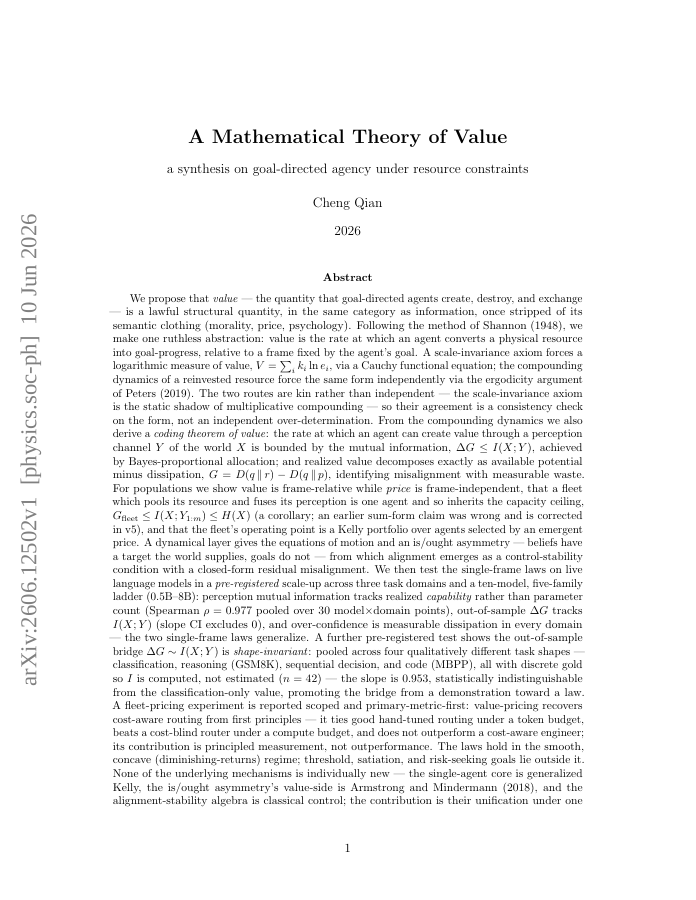
We propose that value -- the quantity goal-directed agents create, destroy, and exchange -- is a lawful structural quantity in the same category as information. Following Shannon's method, we make one ruthless abstraction: value is the rate at which an agent converts a resource into goal-progress, relative to a frame fixed by its goal. A scale-invariance axiom forces a logarithmic measure, V=\sum_i k_i\ln e_i; compounding of a reinvested resource forces the same form via the ergodicity argument of Peters (2019) -- kin routes, a consistency check, not an over-determination. We derive a coding theorem of value, ΔG \le I(X;Y); realized value decomposes as G=D(q|r)-D(q|p). For populations, value is frame-relative while price is frame-independent; a fleet that pools its resource and fuses its perception inherits the ceiling G_{\rm fleet}\le I(X;Y_{1:m})\le H(X) (a corollary; an earlier sum-form claim was wrong and is corrected in v5). A dynamical layer yields an is/ought asymmetry from which alignment emerges as a control-stability condition. We test the single-frame laws on live language models, pre-registered: perception mutual information tracks realized capability (Spearman ρ=0.977 over 30 model\timesdomain points); out-of-sample ΔG tracks I(X;Y), shape-invariant across four task shapes (n=42, slope 0.953); over-confidence is measurable dissipation. The stated continuation gate has since been run (pre-registered, frontier-model population): the coupled capacity-region prediction -- growth-gap law, coalition submodularity with an XOR synergy control, joint ceiling, Kelly selection -- is confirmed within its frozen bands on real agents; the mean-field residual law |Vg|/γ found no domain (populations hold no goal dispersion) and is retired to its mathematical scope. The contribution is the unification and the governance mapping that follows.
A Mathematical Theory of Value: a synthesis on goal-directed agency under resource constraints
We propose that value -- the quantity goal-directed agents create, destroy, and exchange -- is a lawful structural quantity in the same category as information. Following Shannon's method, we make one ruthless abstraction: value is the rate at which an agent converts a resource…
- Preview
- Year
- 2026
- Hosting
- Full text hostedCC-BY-4.0
Cite
Notes
Only stored in your browser.
Attribution
- Abstract & full text
- arxiv.org/abs/2606.12502CC-BY-4.0
- TL;DR
- Semantic Scholar