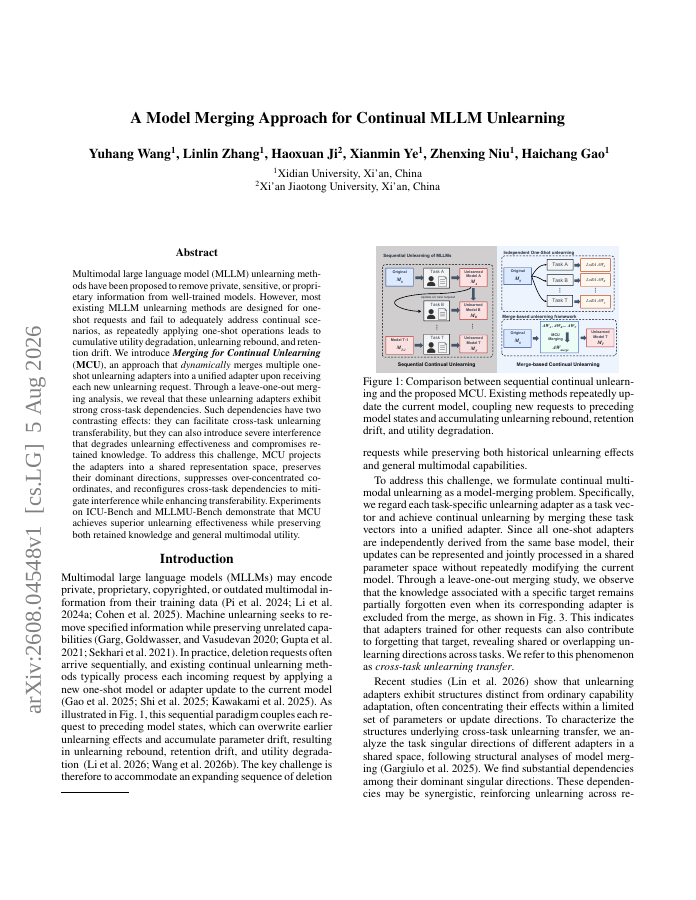
Multimodal large language model (MLLM) unlearning methods have been proposed to remove private, sensitive, or proprietary information from well-trained models. However, most existing MLLM unlearning methods are designed for one-shot requests and fail to adequately address continual scenarios, as repeatedly applying one-shot operations leads to cumulative utility degradation, unlearning rebound, and retention drift. We introduce Merging for Continual Unlearning (MCU), an approach that dynamically merges multiple one-shot unlearning adapters into a unified adapter upon receiving each new unlearning request.Through a leave-one-out merging analysis, we reveal that these unlearning adapters exhibit strong cross-task dependencies. Such dependencies have two contrasting effects: they can facilitate cross-task unlearning transferability, but they can also introduce severe interference that degrades unlearning effectiveness and compromises retained knowledge. To address this challenge, MCU projects the adapters into a shared representation space, preserves their dominant directions, suppresses over-concentrated coordinates, and reconfigures cross-task dependencies to mitigate interference while enhancing transferability. Experiments on ICU-Bench and MLLMU-Bench demonstrate that MCU achieves superior unlearning effectiveness while preserving both retained knowledge and general multimodal utility.
A Model Merging Approach for Continual MLLM Unlearning
Multimodal large language model (MLLM) unlearning methods have been proposed to remove private, sensitive, or proprietary information from well-trained models. However, most existing MLLM unlearning methods are designed for one-shot requests and fail to adequately address…
- Preview
- Year
- 2026
- Hosting
- Full text hostedCC-BY-4.0
Cite
Notes
Only stored in your browser.
Attribution
- Abstract & full text
- arxiv.org/abs/2608.04548CC-BY-4.0
- TL;DR
- Semantic Scholar