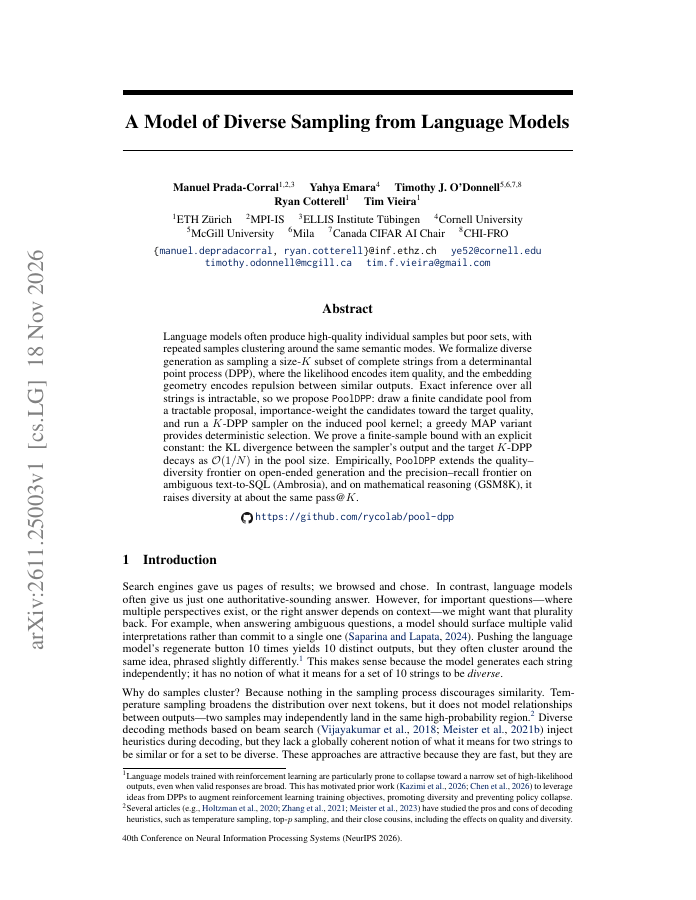
Language models often produce high-quality individual samples but poor sets, with repeated samples clustering around the same semantic modes. We formalize diverse generation as sampling a size-K subset of complete strings from a determinantal point process (DPP), where the likelihood encodes item quality, and the embedding geometry encodes repulsion between similar outputs. Exact inference over all strings is intractable, so we propose PoolDPP: draw a finite candidate pool from a tractable proposal, importance-weight the candidates toward the target quality, and run a K-DPP sampler on the induced pool kernel; a greedy MAP variant provides deterministic selection. We prove a finite-sample bound with an explicit constant: the KL divergence between the sampler's output and the target K-DPP decays as O(1/N) in the pool size. Empirically, PoolDPP extends the quality--diversity frontier on open-ended generation and the precision--recall frontier on ambiguous text-to-SQL (Ambrosia), and on mathematical reasoning (GSM8K), it raises diversity at about the same pass@K.
A Model of Diverse Sampling from Language Models
Language models often produce high-quality individual samples but poor sets, with repeated samples clustering around the same semantic modes. We formalize diverse generation as sampling a size-$K$ subset of complete strings from a determinantal point process (DPP), where the…
- Preview
- Year
- 2026
- Hosting
- Full text hostedCC-BY-4.0
Cite
Notes
Only stored in your browser.
Attribution
- Abstract & full text
- arxiv.org/abs/2611.25003CC-BY-4.0
- TL;DR
- Semantic Scholar