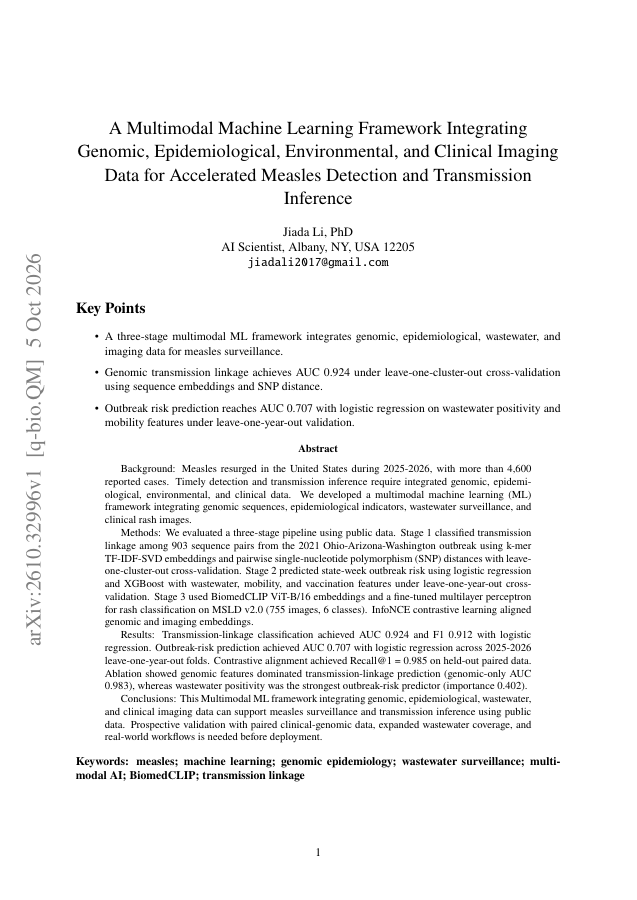
Background: Measles resurged in the United States during 2025-2026, with more than 4,600 reported cases. Timely detection and transmission inference require integrated genomic, epidemiological, environmental, and clinical data. We developed a multimodal machine learning (ML) framework integrating genomic sequences, epidemiological indicators, wastewater surveillance, and clinical rash images. Methods: We evaluated a three-stage pipeline using public data. Stage 1 classified transmission linkage among 903 sequence pairs from the 2021 Ohio-Arizona-Washington outbreak using k-mer TF-IDF-SVD embeddings and pairwise single-nucleotide polymorphism (SNP) distances with leave-one-cluster-out cross-validation. Stage 2 predicted state-week outbreak risk using logistic regression and XGBoost with wastewater, mobility, and vaccination features under leave-one-year-out cross-validation. Stage 3 used BiomedCLIP ViT-B/16 embeddings and a fine-tuned multilayer perceptron for rash classification on MSLD v2.0 (755 images, 6 classes). InfoNCE contrastive learning aligned genomic and imaging embeddings. Results: Transmission-linkage classification achieved AUC 0.924 and F1 0.912 with logistic regression. Outbreak-risk prediction achieved AUC 0.707 with logistic regression across 2025-2026 leave-one-year-out folds. Contrastive alignment achieved Recall@1 = 0.985 on held-out paired data. Ablation showed genomic features dominated transmission-linkage prediction (genomic-only AUC 0.983), whereas wastewater positivity was the strongest outbreak-risk predictor (importance 0.402). Conclusions: Multimodal ML integrating genomic, epidemiological, wastewater, and clinical imaging data can support measles surveillance and transmission inference using public data. Prospective validation with paired clinical-genomic data, expanded wastewater coverage, and real-world workflows is needed before deployment.
A Multimodal Machine Learning Framework Integrating Genomic, Epidemiological, Environmental, and Clinical Imaging Data for Accelerated Measles Detection and Transmission Inference
Background: Measles resurged in the United States during 2025-2026, with more than 4,600 reported cases. Timely detection and transmission inference require integrated genomic, epidemiological, environmental, and clinical data.
- Preview
- Year
- 2026
- Hosting
- Full text hostedCC-BY-4.0
Cite
Notes
Only stored in your browser.
Attribution
- Abstract & full text
- arxiv.org/abs/2610.32996CC-BY-4.0
- TL;DR
- Semantic Scholar