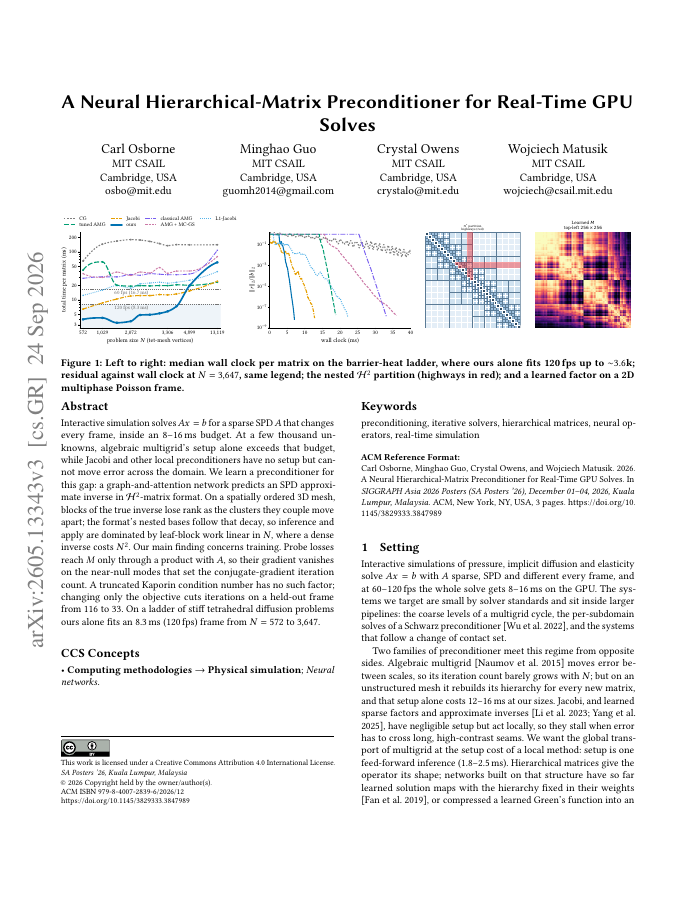
Interactive simulation solves Ax=b for a sparse SPD A that changes every frame, inside an 8-16 ms budget. At a few thousand unknowns, the setup of algebraic multigrid alone exceeds that budget, while Jacobi and other local preconditioners have no setup but cannot move error across the domain. We learn a preconditioner for this gap: a graph-and-attention network predicts an SPD approximate inverse in H^2-matrix format. On a spatially ordered 3D mesh, blocks of the true inverse lose rank as the clusters they couple move apart; the nested bases of the format follow that decay, so inference and apply are dominated by leaf-block work linear in N, where a dense inverse costs N^2. Our main finding concerns training. Probe losses reach M only through a product with A, so their gradient vanishes on the near-null modes that set the conjugate-gradient iteration count. A truncated Kaporin condition number has no such factor; changing only the objective cuts iterations on a held-out frame from 116 to 33. On a ladder of stiff tetrahedral diffusion problems ours alone fits an 8.3 ms (120 fps) frame from N=572 to 3,647.
A Neural Hierarchical-Matrix Preconditioner for Real-Time GPU Solves
Interactive simulation solves Ax=b for a sparse SPD A that changes every frame, inside an 8-16 ms budget. At a few thousand unknowns, the setup of algebraic multigrid alone exceeds that budget, while Jacobi and other local preconditioners have no setup but cannot move error…
- Preview
- Year
- 2026
- Hosting
- Abstract onlyARXIV-DEFAULT
Cite
Notes
Only stored in your browser.
Attribution
- Abstract & full text
- arxiv.org/abs/2605.13343ARXIV-DEFAULT
- TL;DR
- Semantic Scholar