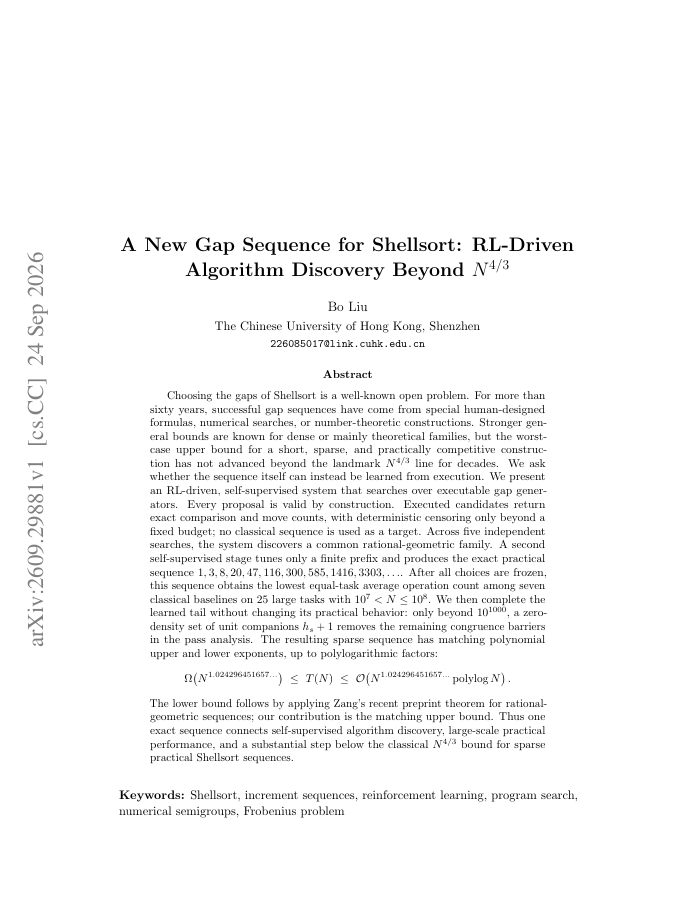
Choosing Shellsort gaps is a well-known open problem. For over sixty years, successful sequences have relied on human-designed formulas, numerical searches, or number-theoretic constructions. Although stronger general bounds exist for dense or mainly theoretical families, the worst-case upper bound for a short, sparse, and practically competitive construction has not advanced beyond N^{4/3} for decades. We ask whether the sequence itself can instead be learned from execution. We present an RL-driven, self-supervised system that searches over executable gap generators. Every proposal is valid by construction, and executed candidates return exact comparison and move counts; no classical sequence is used as a target. Across five independent searches, the system discovers a common rational-geometric family. A second self-supervised stage tunes only a finite prefix, producing the practical sequence 1,3,8,20,47,116,300,585,1416,3303,\ldots. Once frozen, it obtains the lowest equal-task average operation count among seven classical baselines on 25 large tasks with 10^7<N\leq 10^8. We complete the learned tail without changing its practical behavior: only beyond 10^{1000}, a zero-density set of unit companions h_s+1 removes the remaining congruence barriers. The resulting sparse sequence has matching polynomial upper and lower exponents, up to polylogarithmic factors: Ω(N^{1.024296451657\ldots}) \leq T(N) \leq O(N^{1.024296451657\ldots}\operatorname{polylog} N). The lower bound follows from Zang's recent theorem for rational-geometric sequences; our contribution is the matching upper bound. Thus one exact sequence connects self-supervised discovery, large-scale practical performance, and a substantial step below the classical N^{4/3} bound for sparse practical Shellsort sequences.
A New Gap Sequence for Shellsort: RL-Driven Algorithm Discovery Beyond $N^{4/3}$
Choosing Shellsort gaps is a well-known open problem. For over sixty years, successful sequences have relied on human-designed formulas, numerical searches, or number-theoretic constructions.
- Preview
- Year
- 2026
- Hosting
- Full text hostedCC-BY-4.0
Cite
Notes
Only stored in your browser.
Attribution
- Abstract & full text
- arxiv.org/abs/2609.29881CC-BY-4.0
- TL;DR
- Semantic Scholar