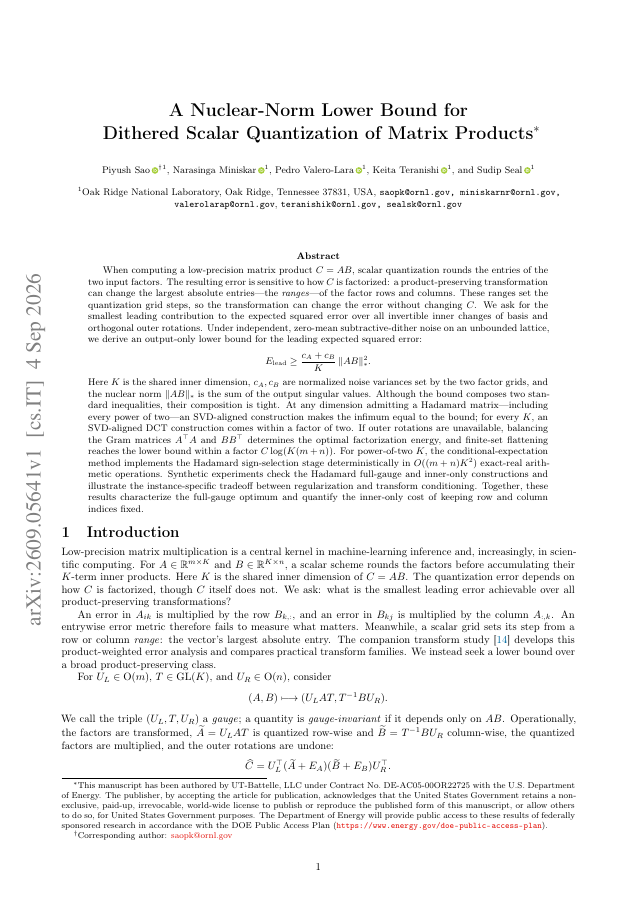
We consider the problem of minimizing error in quantized matrix multiplication C=AB. Scalar quantization of the factors introduces rounding errors whose scale depends on the maximum absolute entries -- the ranges -- of their rows and columns. These ranges determine the quantization grid steps. To reduce the error, we optimize over product-preserving transformations that alter the factor ranges and grid steps without changing C. Specifically, we seek the smallest leading expected squared error over invertible inner changes of basis and orthogonal outer rotations. Under independent, zero-mean subtractive dither noise on an unbounded lattice, we prove the output-only bound E_{\rm lead} \ge (c_A+c_B)/K \Vert AB\Vert_^2, where K is the inner dimension, c_A and c_B are normalized noise variances, and \Vert AB\Vert_ is the nuclear norm. The bound is tight: an SVD-aligned Hadamard construction attains the infimum whenever a Hadamard matrix of order K exists, including every power of two, while an SVD-aligned DCT construction is within a factor of two for every K. Without outer rotations, Gram-matrix balancing minimizes factorization energy, and finite-set flattening achieves the bound within C\log(K(m+n)). For power-of-two K, conditional expectations deterministically select the Hadamard signs in O((m+n)K^2) exact-real operations. Synthetic experiments verify both constructions and illustrate the tradeoff between regularization and conditioning. These results characterize the full-gauge optimum and quantify the cost of preserving row and column indices.
A Nuclear-Norm Lower Bound for Dithered Scalar Quantization of Matrix Products
We consider the problem of minimizing error in quantized matrix multiplication $C=AB$. Scalar quantization of the factors introduces rounding errors whose scale depends on the maximum absolute entries -- the ranges -- of their rows and columns.
- Preview
- Year
- 2026
- Hosting
- Full text hostedCC-BY-4.0
Cite
Notes
Only stored in your browser.
Attribution
- Abstract & full text
- arxiv.org/abs/2609.05641CC-BY-4.0
- TL;DR
- Semantic Scholar