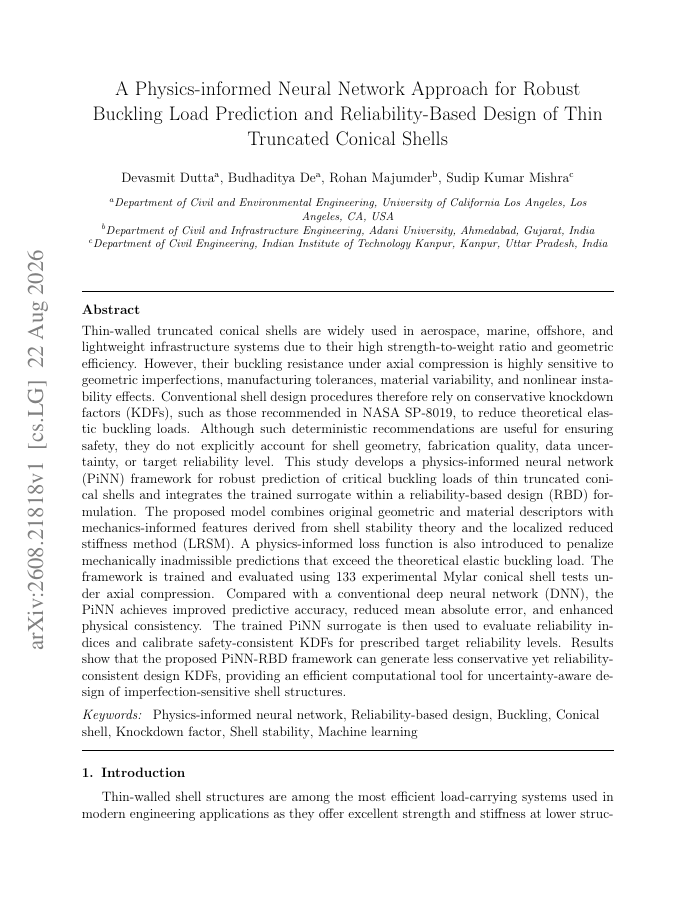
Thin-walled truncated conical shells are widely used in aerospace, marine, offshore, and lightweight infrastructure systems due to their high strength-to-weight ratio and geometric efficiency. Their buckling resistance under axial compression, however, is highly sensitive to geometric imperfections, manufacturing tolerances, material variability, and nonlinear instability effects. Conventional design procedures rely on conservative knockdown factors (KDFs), such as those recommended in NASA SP-8019, which do not explicitly account for shell geometry, fabrication quality, data uncertainty, or target reliability. This study develops a physics-informed neural network (PiNN) framework for predicting critical buckling loads of thin truncated conical shells and integrates the trained surrogate within a reliability-based design (RBD) formulation. The model combines geometric and material descriptors with mechanics-informed features derived from shell stability theory and the localized reduced stiffness method (LRSM). A physics-informed loss function penalizes mechanically inadmissible predictions exceeding the theoretical elastic buckling load. The framework is trained and evaluated using 133 experimental Mylar conical shell tests under axial compression. Compared with a conventional deep neural network (DNN), the PiNN improves predictive accuracy, reduces mean absolute error, and enhances physical consistency. The trained PiNN is then used to evaluate reliability indices and calibrate safety-consistent KDFs for prescribed target reliability levels. Results demonstrate that the PiNN-RBD framework provides an efficient approach for uncertainty-aware design of imperfection-sensitive shell structures.
A Physics-informed Neural Network Approach for Robust Buckling Load Prediction and Reliability-Based Design of Thin Truncated Conical Shells
Thin-walled truncated conical shells are widely used in aerospace, marine, offshore, and lightweight infrastructure systems due to their high strength-to-weight ratio and geometric efficiency.
- Preview
- Year
- 2026
- Hosting
- Abstract onlyARXIV-DEFAULT
Cite
Notes
Only stored in your browser.
Attribution
- Abstract & full text
- arxiv.org/abs/2608.21818ARXIV-DEFAULT
- TL;DR
- Semantic Scholar