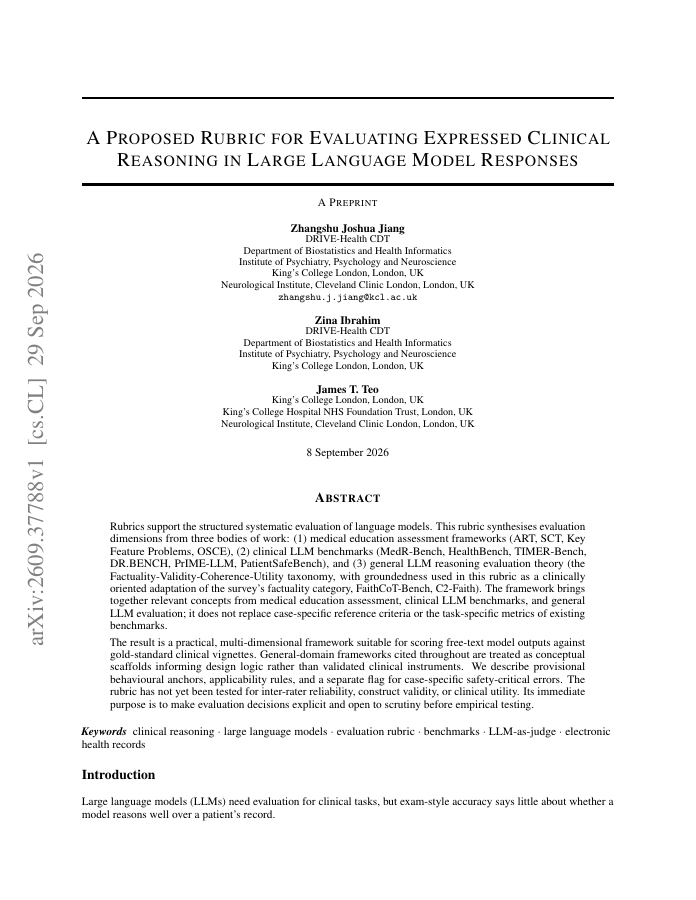
We propose a rubric for assessing expressed clinical reasoning in model responses, drawing on three bodies of work: medical education assessment frameworks (ART, SCT, Key Feature Problems and OSCE); clinical LLM benchmarks (MedR-Bench, HealthBench, TIMER-Bench, DR. BENCH, PrIME-LLM and PatientSafeBench); and general LLM reasoning evaluation research, including the Factuality-Validity-Coherence-Utility taxonomy, FaithCoT-Bench and C2-Faith. We use groundedness as a clinically oriented adaptation of the taxonomy's factuality category. The rubric brings these concepts together in a multidimensional framework for scoring free-text responses to gold-standard clinical vignettes. It includes provisional behavioural anchors, applicability rules and a separate flag for case-specific safety-critical errors. General-domain frameworks inform its design but are not treated as validated clinical instruments. The rubric does not replace case-specific reference criteria or the task-specific metrics of existing benchmarks. It has not yet been tested for inter-rater reliability, construct validity or clinical utility. Its immediate purpose is to make evaluation decisions explicit and open to scrutiny before empirical testing.
A Proposed Rubric for Evaluating Expressed Clinical Reasoning in Large Language Model Responses
We propose a rubric for assessing expressed clinical reasoning in model responses, drawing on three bodies of work: medical education assessment frameworks (ART, SCT, Key Feature Problems and OSCE); clinical LLM benchmarks (MedR-Bench, HealthBench, TIMER-Bench, DR.
- Preview
- Year
- 2026
- Hosting
- Full text hostedCC-BY-4.0
Cite
Notes
Only stored in your browser.
Attribution
- Abstract & full text
- arxiv.org/abs/2609.37788CC-BY-4.0
- TL;DR
- Semantic Scholar