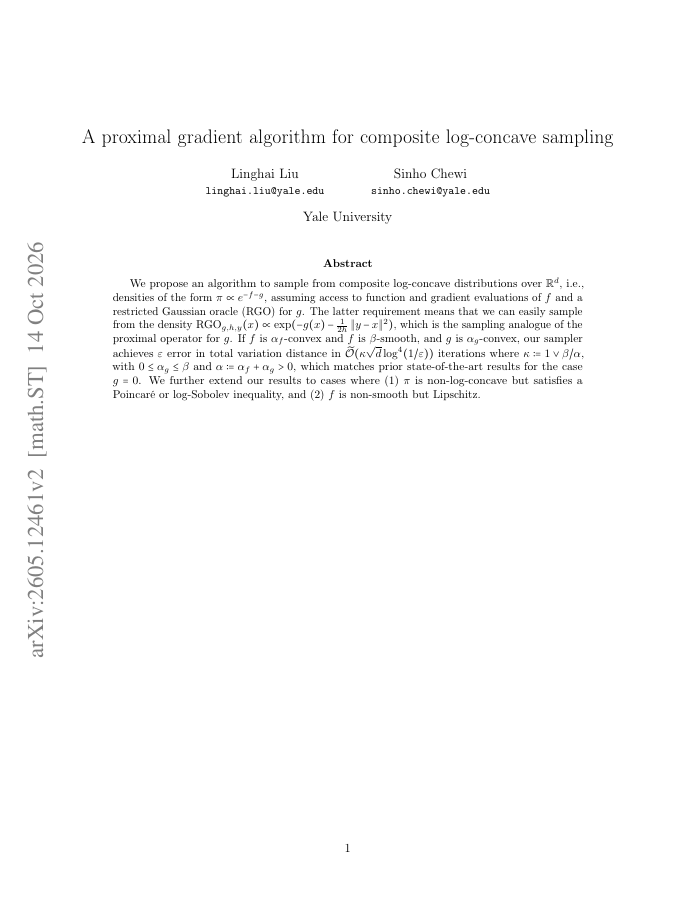
We propose an algorithm to sample from composite log-concave distributions over \mathbb{R}^d, i.e., densities of the form π\propto e^{-f-g}, assuming access to gradient evaluations of α_f-convex f and a restricted Gaussian oracle (RGO) for α_g-convex g, where α_g \ge 0. The latter requirement means that we can easily sample from the density RGO_{g,h,y}(x) \propto \exp(-g(x) -\frac{1}{2h}||y-x||^2), which is the sampling analogue of the proximal operator for g. If f + g is α-convex and f is β-smooth, our sampler achieves \varepsilon error in total variation distance using \widetilde{\mathcal O}(κ\sqrt d \log^4(1/\varepsilon)) oracle calls where κ:= 1 \vee β/α, with 0\le α_g \le β and α:= α_f + α_g > 0, which matches prior state-of-the-art results for the case g=0. We further extend our results to cases where (1) π is non-log-concave but satisfies a Poincaré or log-Sobolev inequality, and (2) f is non-smooth but Lipschitz.
A proximal gradient algorithm for composite log-concave sampling
We propose an algorithm to sample from composite log-concave distributions over $\mathbb{R}^d$, i.e., densities of the form $π\propto e^{-f-g}$, assuming access to gradient evaluations of $α_f$-convex $f$ and a restricted Gaussian oracle (RGO) for $α_g$-convex $g$, where $α_g…
- Preview
- Year
- 2026
- Hosting
- Abstract onlyARXIV-DEFAULT
Cite
Notes
Only stored in your browser.
Attribution
- Abstract & full text
- arxiv.org/abs/2605.12461ARXIV-DEFAULT
- TL;DR
- Semantic Scholar