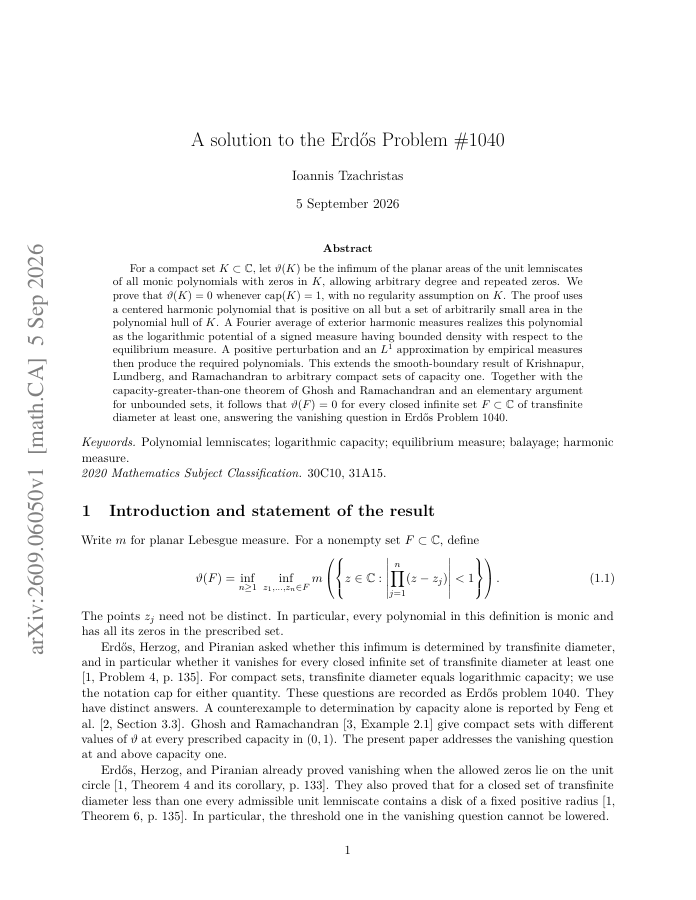
For a compact set K\subset\mathbb{C}, let \vartheta(K) be the infimum of the planar areas of the unit lemniscates of all monic polynomials with zeros in K, allowing arbitrary degree and repeated zeros. We prove that \vartheta(K)=0 whenever \operatorname{cap}(K)=1, with no regularity assumption on K. The proof uses a centered harmonic polynomial that is positive on all but a set of arbitrarily small area in the polynomial hull of K. A Fourier average of exterior harmonic measures realizes this polynomial as the logarithmic potential of a signed measure having bounded density with respect to the equilibrium measure. A positive perturbation and an L^1 approximation by empirical measures then produce the required polynomials. This extends the smooth-boundary result of Krishnapur, Lundberg, and Ramachandran to arbitrary compact sets of capacity one. Together with the capacity-greater-than-one theorem of Ghosh and Ramachandran and an elementary argument for unbounded sets, it follows that \vartheta(F)=0 for every closed infinite set F\subset\mathbb{C} of transfinite diameter at least one, answering the vanishing question in Erdős Problem 1040.
A solution to the Erdős Problem #1040
For a compact set $K\subset\mathbb{C}$, let $\vartheta(K)$ be the infimum of the planar areas of the unit lemniscates of all monic polynomials with zeros in $K$, allowing arbitrary degree and repeated zeros.
- Preview
- Year
- 2026
- Hosting
- Full text hostedCC-BY-4.0
Cite
Notes
Only stored in your browser.
Attribution
- Abstract & full text
- arxiv.org/abs/2609.06050CC-BY-4.0
- TL;DR
- Semantic Scholar