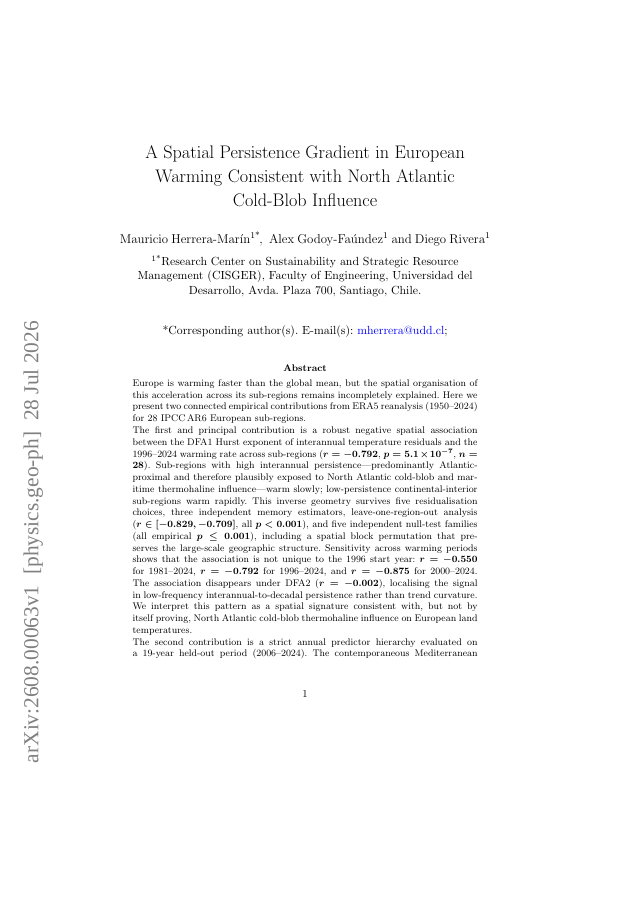
Europe is warming faster than the global mean, yet the spatial organisation of this acceleration remains incompletely understood. Using ERA5 reanalysis for 1950--2024 across 28 IPCC AR6 European sub-regions, we identify two connected empirical results. First, the DFA1 Hurst exponent of interannual temperature residuals is strongly and negatively associated with the 1996--2024 warming rate (r=-0.792, p=5.1\times10^{-7}). High-persistence, mainly Atlantic-proximal regions warm more slowly, whereas low-persistence continental regions warm faster. This relationship is robust to five residualisation schemes, three memory estimators, leave-one-region-out analysis, and five null-test families, including spatial block permutation. It also persists across warming windows (r=-0.550 for 1981--2024, -0.792 for 1996--2024, and -0.875 for 2000--2024), but vanishes under DFA2, indicating that the signal lies in low-frequency interannual-to-decadal persistence rather than trend curvature. The pattern is consistent with, but does not prove, North Atlantic cold-blob and thermohaline influence on European land temperatures. Second, under a strict 2006--2024 holdout, contemporaneous Mediterranean SST reduces mean annual temperature RMSE by 43% (from 0.787 to 0.449,^{\circ}C). A causal lag-weight predictor based on prior-year Mediterranean and Atlantic SST also outperforms AR(2) (0.578 versus 0.695,^{\circ}C) and remains informative after removing NAO, AO, and PNA effects. Similar skill from five-year moving-average and exponentially weighted predictors shows that short Mediterranean SST persistence at 1--5-year lags is the key predictive ingredient. Together, the results support a two-regime interpretation: Atlantic-proximal regions exhibit stronger memory and oceanic buffering, while continental interiors show faster warming and weaker interannual persistence.
A Spatial Persistence Gradient in European Warming Consistent with North Atlantic Cold-Blob Influence
Europe is warming faster than the global mean, yet the spatial organisation of this acceleration remains incompletely understood. Using ERA5 reanalysis for 1950--2024 across 28 IPCC AR6 European sub-regions, we identify two connected empirical results.
- Preview
- Year
- 2026
- Hosting
- Full text hostedCC-BY-4.0
Cite
Notes
Only stored in your browser.
Attribution
- Abstract & full text
- arxiv.org/abs/2608.00063CC-BY-4.0
- TL;DR
- Semantic Scholar