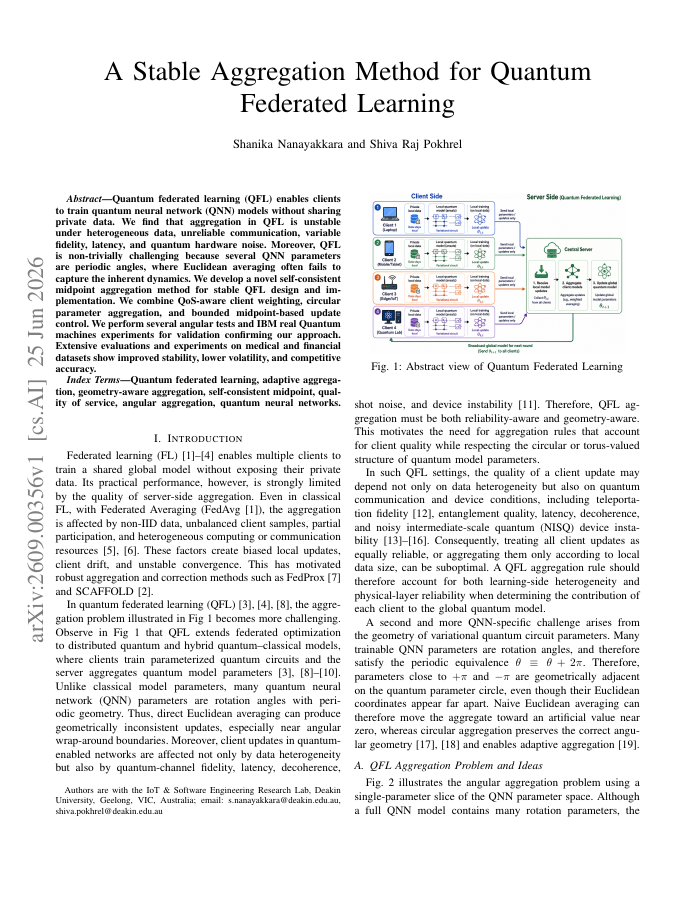
Quantum federated learning (QFL) enables clients to train quantum neural network (QNN) models without sharing private data. We find that aggregation in QFL is unstable under heterogeneous data, unreliable communication, variable fidelity, latency, and quantum hardware noise. Moreover, QFL is non-trivially challenging because several QNN parameters are periodic angles, where Euclidean averaging often fails to capture the inherent dynamics. We develop a novel self-consistent midpoint aggregation method for stable QFL design and implementation. We combine QoS-aware client weighting, circular parameter aggregation, and bounded midpoint-based update control. We perform several angular tests and IBM real Quantum machines experiments for validation confirming our approach. Extensive evaluations and experiments on medical and financial datasets show improved stability, lower volatility, and competitive accuracy.
A Stable Aggregation Method for Quantum Federated Learning
Quantum federated learning (QFL) enables clients to train quantum neural network (QNN) models without sharing private data. We find that aggregation in QFL is unstable under heterogeneous data, unreliable communication, variable fidelity, latency, and quantum hardware noise.
- Preview
- Year
- 2026
- Hosting
- Full text hostedCC-BY-4.0
Cite
Notes
Only stored in your browser.
Attribution
- Abstract & full text
- arxiv.org/abs/2609.00356CC-BY-4.0
- TL;DR
- Semantic Scholar