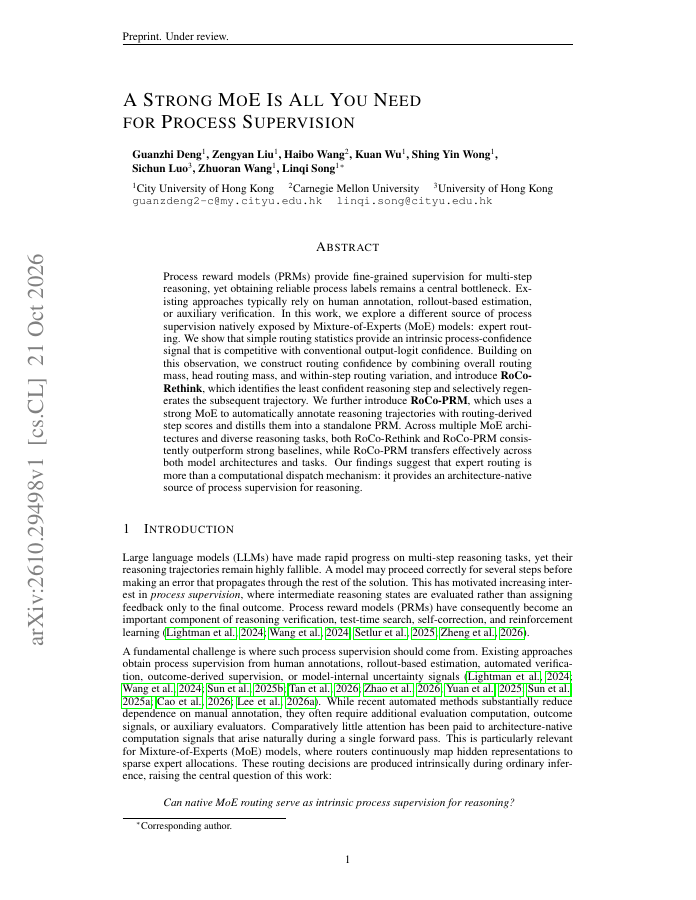
Process reward models (PRMs) provide fine-grained supervision for multi-step reasoning, yet obtaining reliable process labels remains a central bottleneck. Existing approaches typically rely on human annotation, rollout-based estimation, or auxiliary verification. In this work, we explore a different source of process supervision natively exposed by Mixture-of-Experts (MoE) models: expert routing. We show that simple routing statistics provide an intrinsic process-confidence signal that is competitive with conventional output-logit confidence. Building on this observation, we construct routing confidence by combining overall routing mass, head routing mass, and within-step routing variation, and introduce RoCo-Rethink, which identifies the least confident reasoning step and selectively regenerates the subsequent trajectory. We further introduce RoCo-PRM, which uses a strong MoE to automatically annotate reasoning trajectories with routing-derived step scores and distills them into a standalone PRM. Across multiple MoE architectures and diverse reasoning tasks, both RoCo-Rethink and RoCo-PRM consistently outperform strong baselines, while RoCo-PRM transfers effectively across both model architectures and tasks. Our findings suggest that expert routing is more than a computational dispatch mechanism: it provides an architecture-native source of process supervision for reasoning.
A Strong MoE Is All You Need for Process Supervision
Process reward models (PRMs) provide fine-grained supervision for multi-step reasoning, yet obtaining reliable process labels remains a central bottleneck. Existing approaches typically rely on human annotation, rollout-based estimation, or auxiliary verification.
- Preview
- Year
- 2026
- Hosting
- Full text hostedCC-BY-4.0
Cite
Notes
Only stored in your browser.
Attribution
- Abstract & full text
- arxiv.org/abs/2610.29498CC-BY-4.0
- TL;DR
- Semantic Scholar