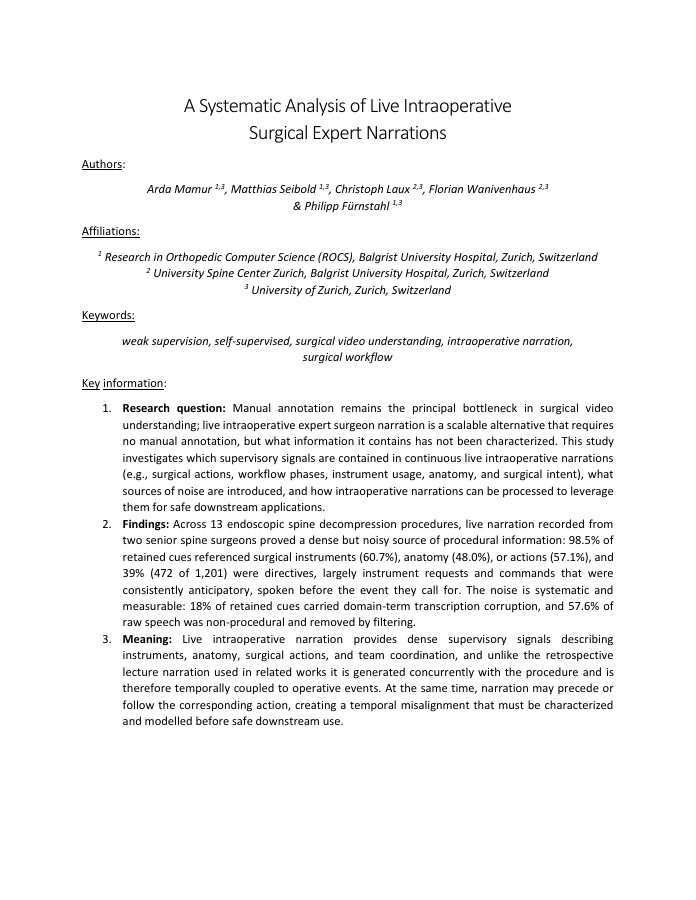
Manual annotation remains the principal bottleneck in surgical video understanding. Live intraoperative narration by the operating surgeon is a scalable alternative that requires no manual annotation, but the information it contains has not been characterized. We analyzed 13 endoscopic lumbar spine decompression procedures (13.2 h) by two senior spine surgeons, using time-synchronized close-mic German audio. An annotation-free pipeline (word-level speech recognition, deterministic correction of surgical-term errors, utterance fusion, LLM-based translation to English, and relevance filtering) converted speech into time-stamped procedural cues labelled with the surgical entities they reference and their speech act. Of 3,171 utterances, 1,201 (37.9%) were retained as procedural cues, while 57.6% were non-procedural and removed. Retained cues referenced instruments (60.7%), anatomy (48.0%) and surgical actions (57.1%), and 98.5% carried at least one of these. 39% of cues (472 of 1,201) were directives, mainly instrument requests and commands. All 467 manually verified instrument requests preceded the instrument's appearance in the field, by a median of 8.2 s. Domain-term transcription corruption affected 18.0% of retained cues. Live narration is thus a dense, annotation-free supervisory signal describing instruments, anatomy, actions and team coordination, but it is noisy and temporally displaced from the events it names, and this displacement must be modelled before safe downstream use.
A Systematic Analysis of Live Intraoperative Surgical Expert Narrations
Manual annotation remains the principal bottleneck in surgical video understanding. Live intraoperative narration by the operating surgeon is a scalable alternative that requires no manual annotation, but the information it contains has not been characterized.
- Preview
- Year
- 2026
- Hosting
- Excerpt onlyCC-BY-NC-4.0
Cite
Notes
Only stored in your browser.
Attribution
- Abstract & full text
- arxiv.org/abs/2611.00028CC-BY-NC-4.0
- TL;DR
- Semantic Scholar