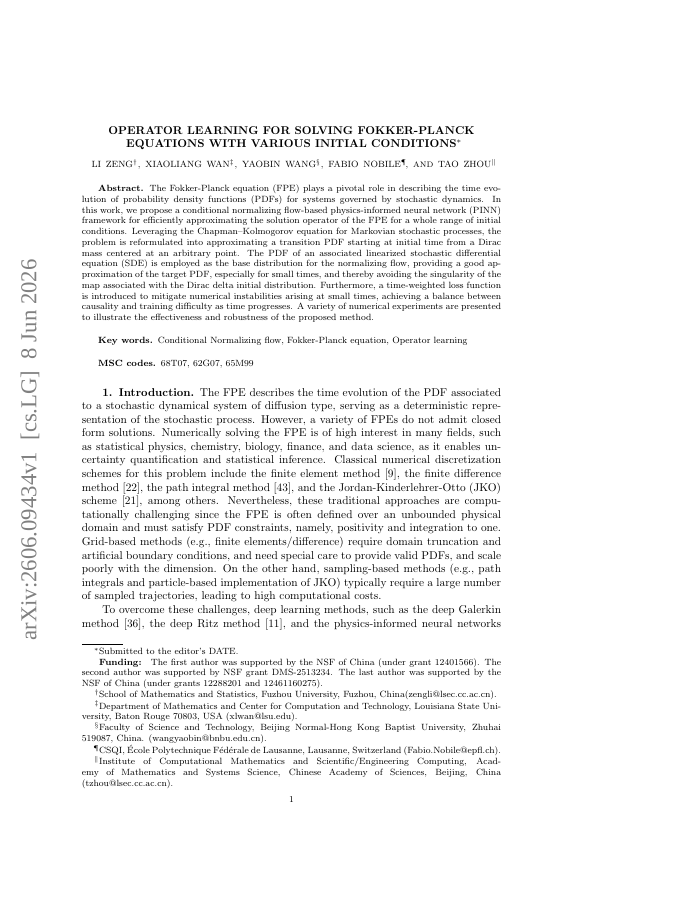
Solving Fokker-Planck equations (FPEs) for multiple initial conditions typically requires repeated computations, leading to substantial computational costs. In this work, we propose a transition-density-based operator learning method to efficiently approximate the solution operator of FPEs with various initial conditions. The core idea is to learn the transition probability density function (PDF) of the underlying stochastic differential equation (SDE), from which the solution associated with a new initial distribution can be obtained through the Chapman-Kolmogorov equation without retraining the model. A major challenge in learning the transition PDF lies in the singular behavior induced by the Dirac initial condition. To address it, we introduce a conditional normalizing flow whose base distribution is given by the explicit transition PDF of a linearized SDE. This base distribution captures the short-time behavior of the target transition PDF and allows the normalizing flow to learn a near-identity transformation at small times. We further incorporate a time-weighted loss function to stabilize training near the initial time and develop an importance-sampling strategy for evaluating solutions associated with general initial conditions. A variety of numerical experiments are presented to illustrate the effectiveness and robustness of the proposed method.
A transition-density-based operator learning method for Fokker-Planck equations with various initial conditions
Solving Fokker-Planck equations (FPEs) for multiple initial conditions typically requires repeated computations, leading to substantial computational costs. In this work, we propose a transition-density-based operator learning method to efficiently approximate the solution…
- Preview
- Year
- 2026
- Hosting
- Abstract onlyARXIV-DEFAULT
Cite
Notes
Only stored in your browser.
Attribution
- Abstract & full text
- arxiv.org/abs/2606.09434ARXIV-DEFAULT
- TL;DR
- Semantic Scholar