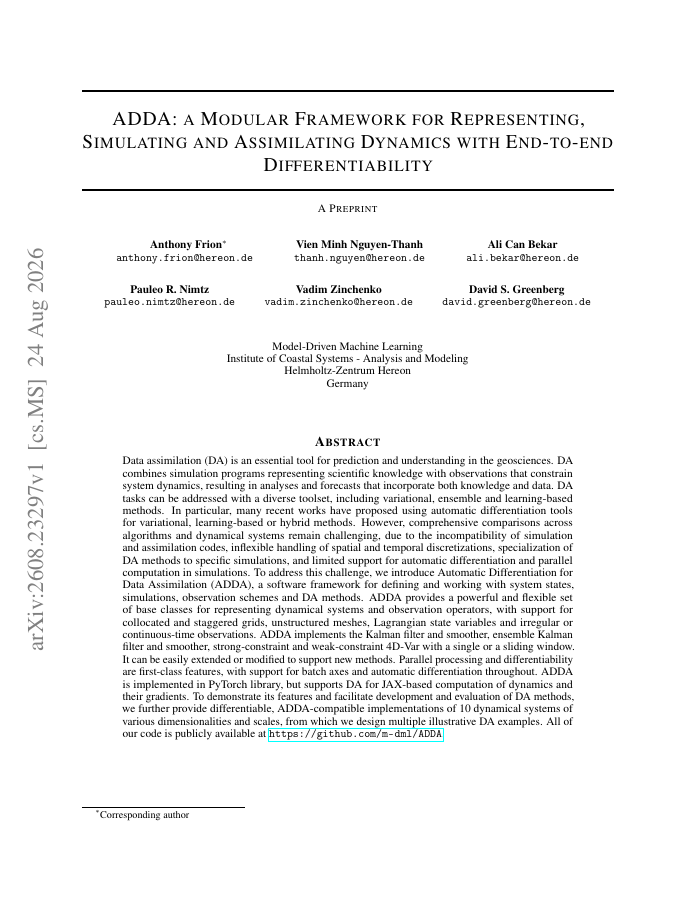
Data assimilation (DA) is an essential tool for prediction and understanding in the geosciences. DA combines simulation programs representing scientific knowledge with observations that constrain system dynamics, resulting in analyses and forecasts that incorporate both knowledge and data. DA tasks can be addressed with a diverse toolset, including variational, ensemble and learning-based methods. In particular, many recent works have proposed using automatic differentiation tools for variational, learning-based or hybrid methods. However, comprehensive comparisons across algorithms and dynamical systems remain challenging, due to the incompatibility of simulation and assimilation codes, inflexible handling of spatial and temporal discretizations, specialization of DA methods to specific simulations, and limited support for automatic differentiation and parallel computation in simulations. To address this challenge, we introduce Automatic Differentiation for Data Assimilation (ADDA), a software framework for defining and working with system states, simulations, observation schemes and DA methods. ADDA provides a powerful and flexible set of base classes for representing dynamical systems and observation operators, with support for collocated and staggered grids, unstructured meshes, Lagrangian state variables and irregular or continuous-time observations. Parallel processing and differentiability are first-class features, with support for batch axes and automatic differentiation throughout. ADDA is implemented in PyTorch library, but supports DA for JAX-based computation of dynamics and their gradients. To demonstrate its features, we further provide differentiable, ADDA-compatible implementations of 10 dynamical systems of various dimensionalities and scales, from which we design multiple illustrative DA examples. All of our code is publicly available at https://github.com/m-dml/ADDA.
ADDA: a Modular Framework for Representing, Simulating and Assimilating Dynamics with End-to-end Differentiability
Data assimilation (DA) is an essential tool for prediction and understanding in the geosciences. DA combines simulation programs representing scientific knowledge with observations that constrain system dynamics, resulting in analyses and forecasts that incorporate both…
- Preview
- Year
- 2026
- Hosting
- Full text hostedCC-BY-4.0
Cite
Notes
Only stored in your browser.
Attribution
- Abstract & full text
- arxiv.org/abs/2608.23297CC-BY-4.0
- TL;DR
- Semantic Scholar