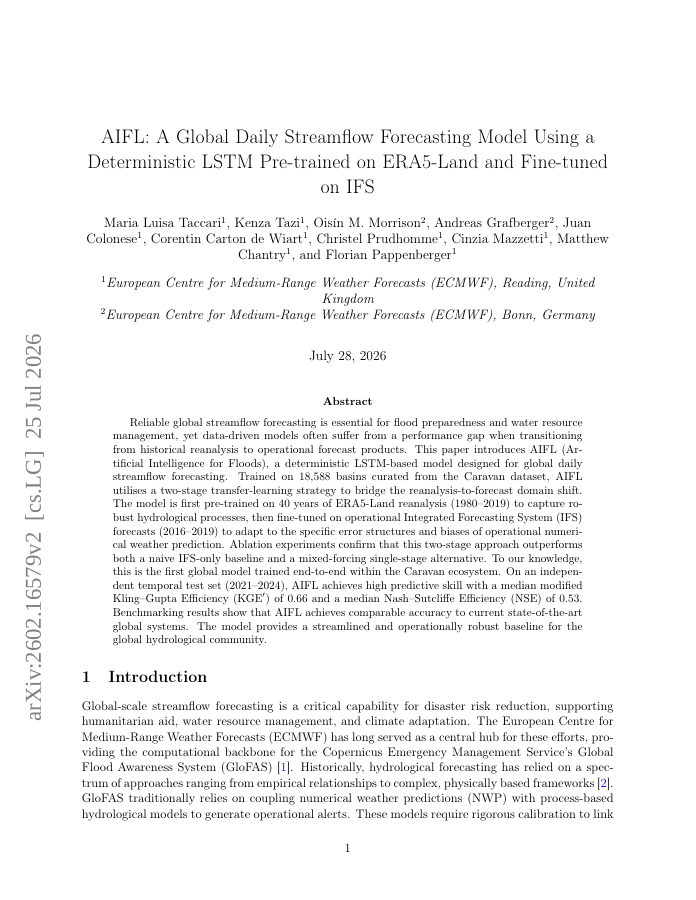
Reliable global streamflow forecasting is essential for flood preparedness and water resource management, yet data-driven models often suffer from a performance gap when transitioning from historical reanalysis to operational forecast products. This paper introduces AIFL (Artificial Intelligence for Floods), a deterministic LSTM-based model designed for global daily streamflow forecasting. Trained on 18,588 basins curated from the Caravan dataset, AIFL utilises a two-stage transfer-learning strategy to bridge the reanalysis-to-forecast domain shift. The model is first pre-trained on 40 years of ERA5-Land reanalysis (1980-2019) to capture robust hydrological processes, then fine-tuned on operational Integrated Forecasting System (IFS) forecasts (2016-2019) to adapt to the specific error structures and biases of operational numerical weather prediction. Ablation experiments confirm that this two-stage approach outperforms both a naive IFS-only baseline and a mixed-forcing single-stage alternative. To our knowledge, this is the first global model trained end-to-end within the Caravan ecosystem. On an independent temporal test set (2021-2024), AIFL achieves high predictive skill with a median modified Kling-Gupta Efficiency (KGE') of 0.66 and a median Nash-Sutcliffe Efficiency (NSE) of 0.53. Benchmarking results show that AIFL achieves comparable accuracy to current state-of-the-art global systems. The model provides a streamlined and operationally robust baseline for the global hydrological community.
AIFL: A Global Daily Streamflow Forecasting Model Using a Deterministic LSTM Pre-trained on ERA5-Land and Fine-tuned on IFS
Reliable global streamflow forecasting is essential for flood preparedness and water resource management, yet data-driven models often suffer from a performance gap when transitioning from historical reanalysis to operational forecast products.
- Preview
- Year
- 2026
- Hosting
- Full text hostedCC-BY-4.0
Cite
Notes
Only stored in your browser.
Attribution
- Abstract & full text
- arxiv.org/abs/2602.16579CC-BY-4.0
- TL;DR
- Semantic Scholar