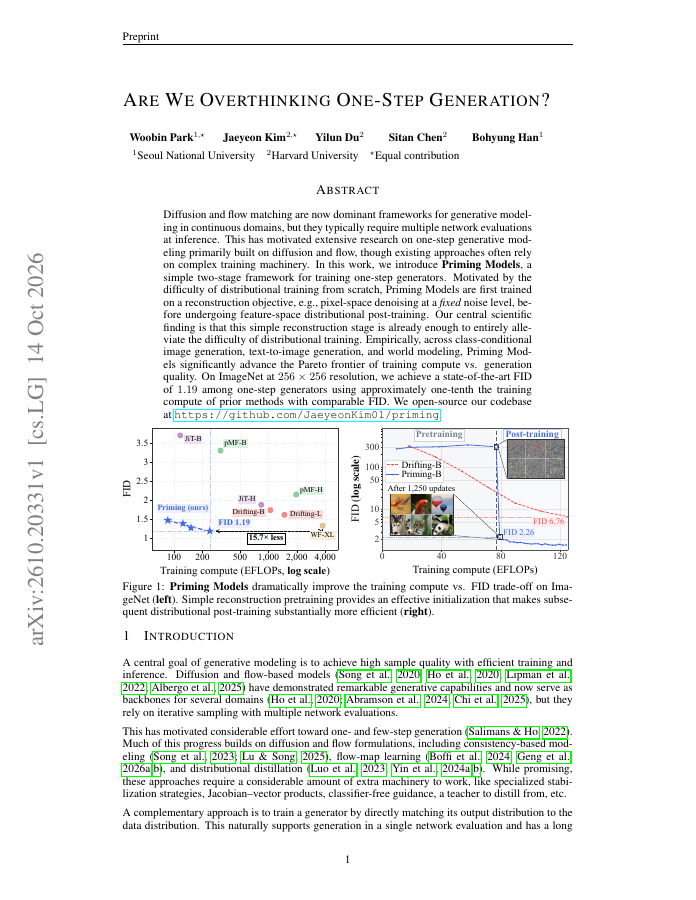
Diffusion and flow matching are now dominant frameworks for generative modeling in continuous domains, but they typically require multiple network evaluations at inference. This has motivated extensive research on one-step generative modeling primarily built on diffusion and flow, though existing approaches often rely on complex training machinery. In this work, we introduce Priming Models, a simple two-stage framework for training one-step generators. Motivated by the difficulty of distributional training from scratch, Priming Models are first trained on a reconstruction objective, e.g., pixel-space denoising at a fixed noise level, before undergoing feature-space distributional post-training. Our central scientific finding is that this simple reconstruction stage is already enough to entirely alleviate the difficulty of distributional training. Empirically, across class-conditional image generation, text-to-image generation, and world modeling, Priming Models significantly advance the Pareto frontier of training compute vs. generation quality. On ImageNet at 256 \times 256 resolution, we achieve a state-of-the-art FID of 1.19 among one-step generators using approximately one-tenth the training compute of prior methods with comparable FID. We open-source our codebase at https://github.com/JaeyeonKim01/priming.
Are We Overthinking One-Step Generation?
Diffusion and flow matching are now dominant frameworks for generative modeling in continuous domains, but they typically require multiple network evaluations at inference.
- Preview
- Year
- 2026
- Stars
- 58
- Hosting
- Full text hostedCC-BY-4.0
Cite
Notes
Only stored in your browser.
Attribution
- Abstract & full text
- arxiv.org/abs/2610.20331CC-BY-4.0
- TL;DR
- Semantic Scholar