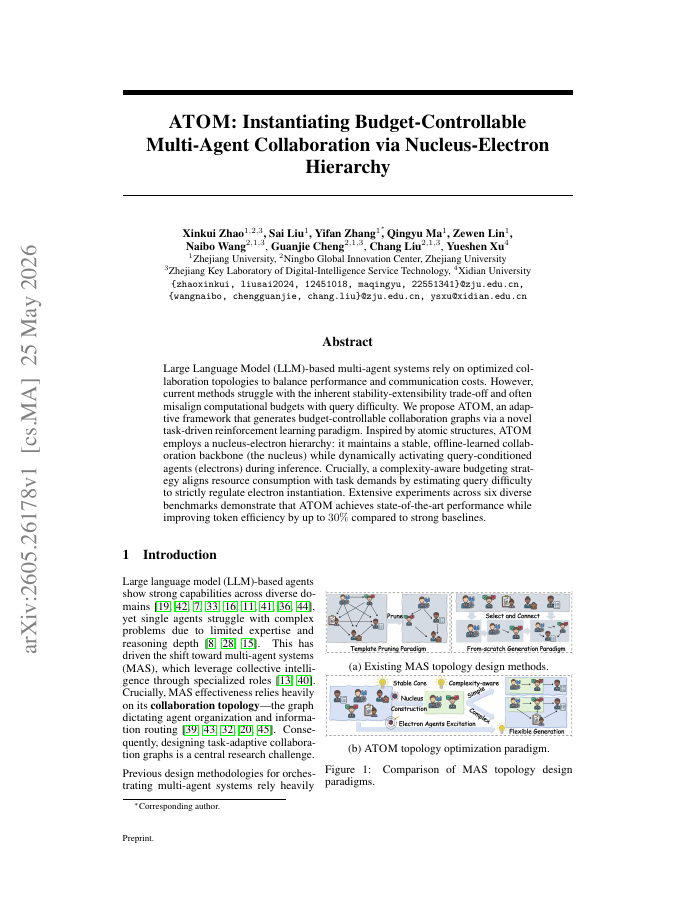
Large Language Model (LLM)-based multi-agent systems rely on optimized collaboration topologies to balance performance and communication costs. However, current methods struggle with the inherent stability-extensibility trade-off and often misalign computational budgets with query difficulty. We propose ATOM, an adaptive framework that generates budget-controllable collaboration graphs via a novel task-driven reinforcement learning paradigm. Inspired by atomic structures, ATOM employs a nucleus-electron hierarchy: it maintains a stable, offline-learned collaboration backbone (the nucleus) while dynamically activating query-conditioned agents (electrons) during inference. Crucially, a complexity-aware budgeting strategy aligns resource consumption with task demands by estimating query difficulty to strictly regulate electron instantiation. Extensive experiments across six diverse benchmarks demonstrate that ATOM achieves state-of-the-art performance while improving token efficiency by up to 30% compared to strong baselines.
ATOM: Instantiating Budget-Controllable Multi-Agent Collaboration via Nucleus-Electron Hierarchy
Large Language Model (LLM)-based multi-agent systems rely on optimized collaboration topologies to balance performance and communication costs. However, current methods struggle with the inherent stability-extensibility trade-off and often misalign computational budgets with…
- Preview
- Year
- 2026
- Hosting
- Full text hostedCC-BY-4.0
Cite
Notes
Only stored in your browser.
Attribution
- Abstract & full text
- arxiv.org/abs/2605.26178CC-BY-4.0
- TL;DR
- Semantic Scholar