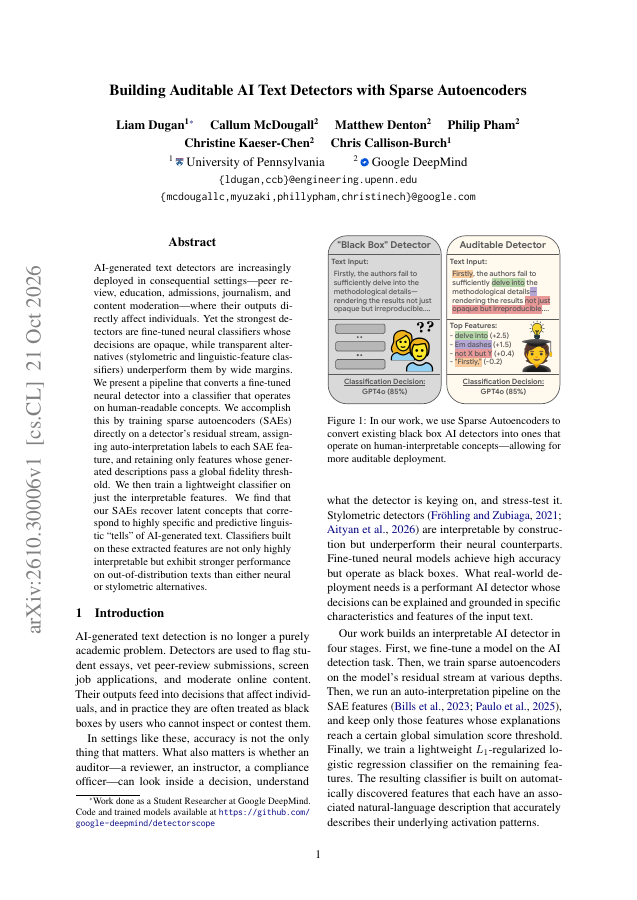
AI-generated text detectors are increasingly deployed in consequential settings---peer review, education, admissions, journalism, and content moderation---where their outputs directly affect individuals. Yet the strongest detectors are fine-tuned neural classifiers whose decisions are opaque, while transparent alternatives (stylometric and linguistic-feature classifiers) underperform them by wide margins. We present a pipeline that converts a fine-tuned neural detector into a classifier that operates on human-readable concepts. We accomplish this by training sparse autoencoders (SAEs) directly on a detector's residual stream, assigning auto-interpretation labels to each SAE feature, and retaining only features whose generated descriptions pass a global fidelity threshold. We then train a lightweight classifier on just the interpretable features. We find that our SAEs recover latent concepts that correspond to highly specific and predictive linguistic "tells" of AI-generated text. Classifiers built on these extracted features are not only highly interpretable but exhibit stronger performance on out-of-distribution texts than either neural or stylometric alternatives.
Building Auditable AI Text Detectors with Sparse Autoencoders
AI-generated text detectors are increasingly deployed in consequential settings---peer review, education, admissions, journalism, and content moderation---where their outputs directly affect individuals.
- Preview
- Year
- 2026
- Stars
- 19
- Hosting
- Abstract onlyARXIV-DEFAULT
Cite
Notes
Only stored in your browser.
Attribution
- Abstract & full text
- arxiv.org/abs/2610.30006ARXIV-DEFAULT
- TL;DR
- Semantic Scholar