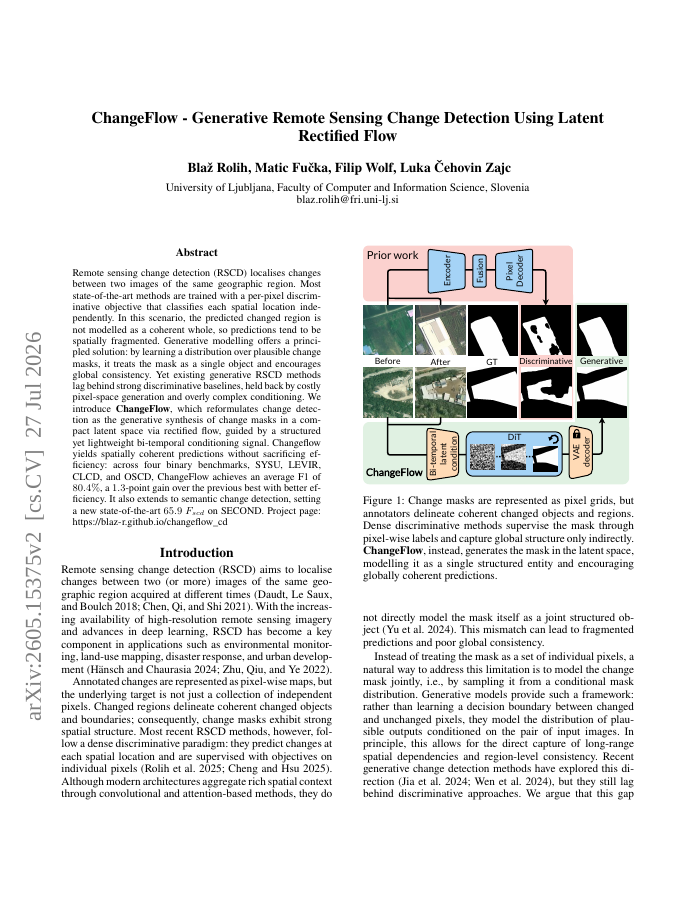
Remote sensing change detection (RSCD) localises changes between two images of the same geographic region. Most state-of-the-art methods are trained with a per-pixel discriminative objective that classifies each spatial location independently. In this scenario, the predicted changed region is not modelled as a coherent whole, so predictions tend to be spatially fragmented. Generative modelling offers a principled solution: by learning a distribution over plausible change masks, it treats the mask as a single object and encourages global consistency. Yet existing generative RSCD methods lag behind strong discriminative baselines, held back by costly pixel-space generation and overly complex conditioning. We introduce ChangeFlow, which reformulates change detection as the generative synthesis of change masks in a compact latent space via rectified flow, guided by a structured yet lightweight bi-temporal conditioning signal. Changeflow yields spatially coherent predictions without sacrificing efficiency: across four binary benchmarks, SYSU, LEVIR, CLCD, and OSCD, ChangeFlow achieves an average F1 of 80.4%, a 1.3-point gain over the previous best with better efficiency. It also extends to semantic change detection, setting a new state-of-the-art 65.9 F_{scd} on SECOND. Project page: https://blaz-r.github.io/changeflow_cd
ChangeFlow -- Latent Rectified Flow for Change Detection in Remote Sensing
Remote sensing change detection (RSCD) localises changes between two images of the same geographic region. Most state-of-the-art methods are trained with a per-pixel discriminative objective that classifies each spatial location independently.
- Preview
- Year
- 2026
- Venue
- arXiv 2026
- Authors
- 4
- Hosting
- Excerpt onlyCC-BY-NC-SA-4.0
Cite
Notes
Only stored in your browser.
Attribution
- Abstract & full text
- arxiv.org/abs/2605.15375CC-BY-NC-SA-4.0
- TL;DR
- Semantic Scholar