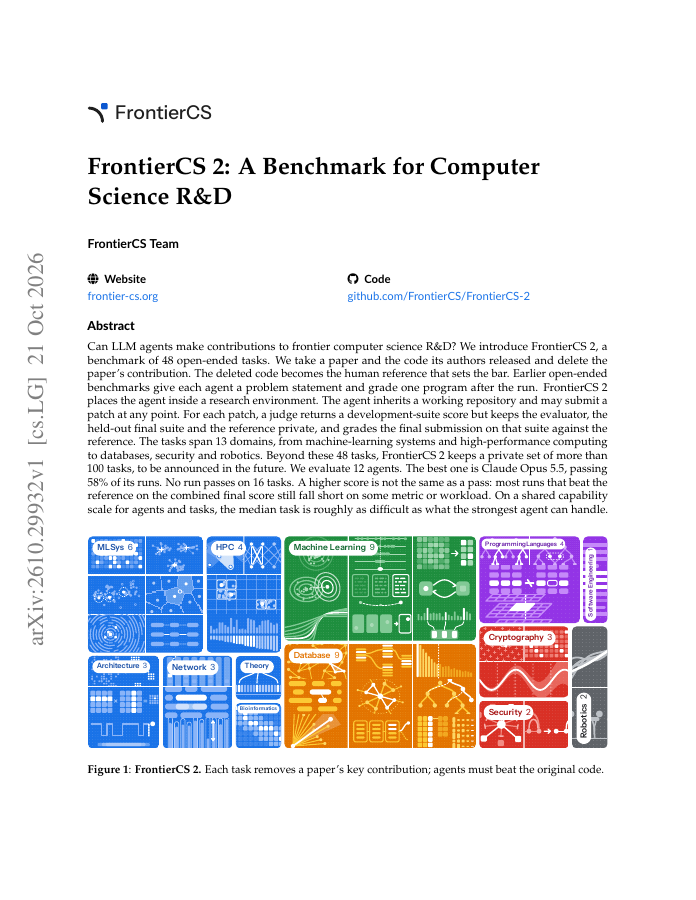
Can LLM agents make contributions to frontier computer science R&D? We introduce FrontierCS 2, a benchmark of 48 open-ended tasks. We take a paper and the code its authors released and delete the paper's contribution. The deleted code becomes the human reference that sets the bar. Earlier open-ended benchmarks give each agent a problem statement and grade one program after the run. FrontierCS 2 places the agent inside a research environment. The agent inherits a working repository and may submit a patch at any point. For each patch, a judge returns a development-suite score but keeps the evaluator, the held-out final suite and the reference private, and grades the final submission on that suite against the reference. The tasks span 13 domains, from machine-learning systems and high-performance computing to databases, security and robotics. Beyond these 48 tasks, FrontierCS 2 keeps a private set of more than 100 tasks, to be announced in the future. We evaluate 12 agents. The best one is Claude Opus 5.5, passing 58% of its runs. No run passes on 16 tasks. A higher score is not the same as a pass: most runs that beat the reference on the combined final score still fall short on some metric or workload. On a shared capability scale for agents and tasks, the median task is roughly as difficult as what the strongest agent can handle.
FrontierCS 2: A Benchmark for Computer Science R&D
Can LLM agents make contributions to frontier computer science R&D? We introduce FrontierCS 2, a benchmark of 48 open-ended tasks. We take a paper and the code its authors released and delete the paper's contribution.
- Preview
- Year
- 2026
- Stars
- 64
- Hosting
- Abstract onlyARXIV-DEFAULT
Cite
Notes
Only stored in your browser.
Attribution
- Abstract & full text
- arxiv.org/abs/2610.29932ARXIV-DEFAULT
- TL;DR
- Semantic Scholar