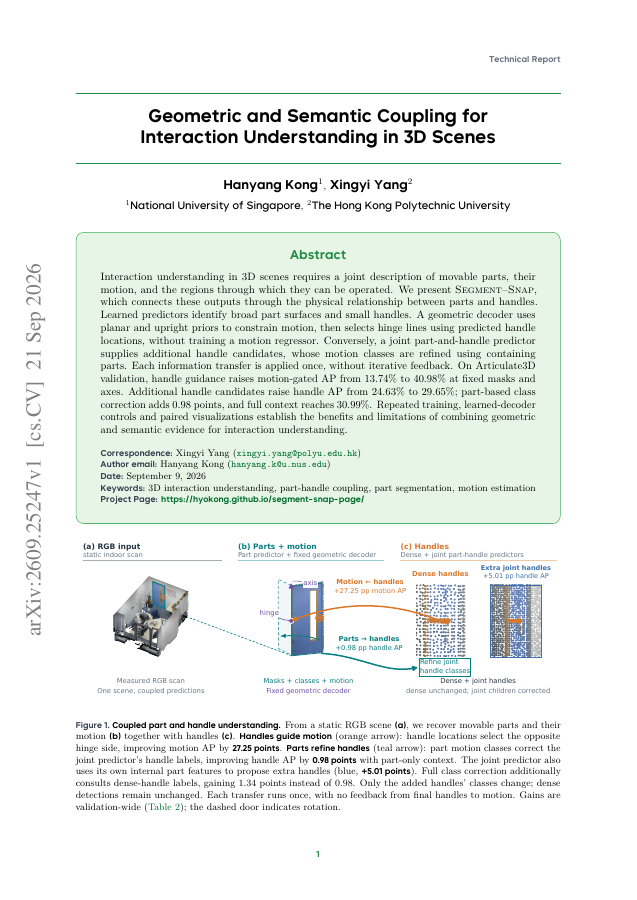
Interaction understanding in 3D scenes requires a joint description of movable parts, their motion, and the regions through which they can be operated. We present Segment-Snap, which connects these outputs through the physical relationship between parts and handles. Learned predictors identify broad part surfaces and small handles. A geometric decoder uses planar and upright priors to constrain motion, then selects hinge lines using predicted handle locations, without training a motion regressor. Conversely, a joint part-and-handle predictor supplies additional handle candidates, whose motion classes are refined using containing parts. Each information transfer is applied once, without iterative feedback. On Articulate3D validation, handle guidance raises motion-gated AP from 13.74% to 40.98% at fixed masks and axes. Additional handle candidates raise handle AP from 24.63% to 29.65%; part-based class correction adds 0.98 points, and full context reaches 30.99%. Repeated training, learned-decoder controls and paired visualizations establish the benefits and limitations of combining geometric and semantic evidence for interaction understanding.
Geometric and Semantic Coupling for Interaction Understanding in 3D Scenes
Interaction understanding in 3D scenes requires a joint description of movable parts, their motion, and the regions through which they can be operated. We present Segment-Snap, which connects these outputs through the physical relationship between parts and handles.
- Preview
- Year
- 2026
- Stars
- 2
- Hosting
- Abstract onlyARXIV-DEFAULT
Cite
Notes
Only stored in your browser.
Attribution
- Abstract & full text
- arxiv.org/abs/2609.25247ARXIV-DEFAULT
- TL;DR
- Semantic Scholar