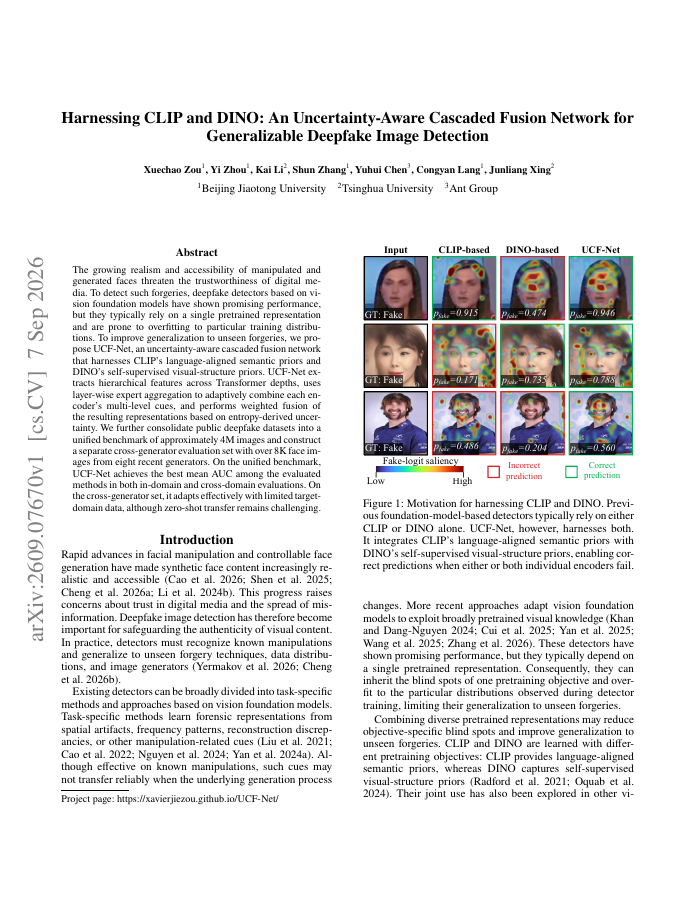
The growing realism and accessibility of manipulated and generated faces threaten the trustworthiness of digital media. To detect such forgeries, deepfake detectors based on vision foundation models have shown promising performance, but they typically rely on a single pretrained representation and are prone to overfitting to particular training distributions. To improve generalization to unseen forgeries, we propose UCF-Net, an uncertainty-aware cascaded fusion network that harnesses CLIP's language-aligned semantic priors and DINO's self-supervised visual-structure priors. UCF-Net extracts hierarchical features across Transformer depths, uses layer-wise expert aggregation to adaptively combine each encoder's multi-level cues, and performs weighted fusion of the resulting representations based on entropy-derived uncertainty. We further consolidate public deepfake datasets into a unified benchmark of approximately 4M images and construct a separate cross-generator evaluation set with over 8K face images from eight recent generators. On the unified benchmark, UCF-Net achieves the best mean AUC among the evaluated methods in both in-domain and cross-domain evaluations. On the cross-generator set, it adapts effectively with limited target-domain data, although zero-shot transfer remains challenging.
Harnessing CLIP and DINO: An Uncertainty-Aware Cascaded Fusion Network for Generalizable Deepfake Image Detection
The growing realism and accessibility of manipulated and generated faces threaten the trustworthiness of digital media. To detect such forgeries, deepfake detectors based on vision foundation models have shown promising performance, but they typically rely on a single pretrained…
- Preview
- Year
- 2026
- Stars
- 6
- Hosting
- Abstract onlyARXIV-DEFAULT
Cite
Notes
Only stored in your browser.
Attribution
- Abstract & full text
- arxiv.org/abs/2609.07670ARXIV-DEFAULT
- TL;DR
- Semantic Scholar