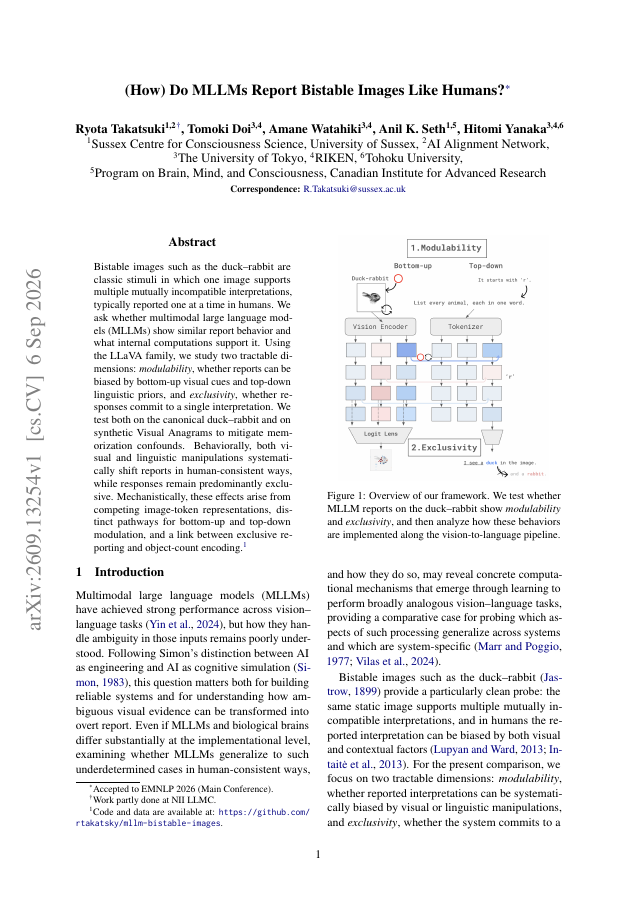
Bistable images such as the duck-rabbit are classic stimuli in which one image supports multiple mutually incompatible interpretations, typically reported one at a time in humans. We ask whether multimodal large language models (MLLMs) show similar report behavior and what internal computations support it. Using the LLaVA family, we study two tractable dimensions: modulability, whether reports can be biased by bottom-up visual cues and top-down linguistic priors, and exclusivity, whether responses commit to a single interpretation. We test both on the canonical duck-rabbit and on synthetic Visual Anagrams to mitigate memorization confounds. Behaviorally, both visual and linguistic manipulations systematically shift reports in human-consistent ways, while responses remain predominantly exclusive. Mechanistically, these effects arise from competing image-token representations, distinct pathways for bottom-up and top-down modulation, and a link between exclusive reporting and object-count encoding. Code and data are available at https://github.com/rtakatsky/mllm-bistable-images.
(How) Do MLLMs Report Bistable Images Like Humans?
Bistable images such as the duck-rabbit are classic stimuli in which one image supports multiple mutually incompatible interpretations, typically reported one at a time in humans.
- Preview
- Year
- 2026
- Hosting
- Abstract onlyARXIV-DEFAULT
Cite
Notes
Only stored in your browser.
Attribution
- Abstract & full text
- arxiv.org/abs/2609.13254ARXIV-DEFAULT
- TL;DR
- Semantic Scholar