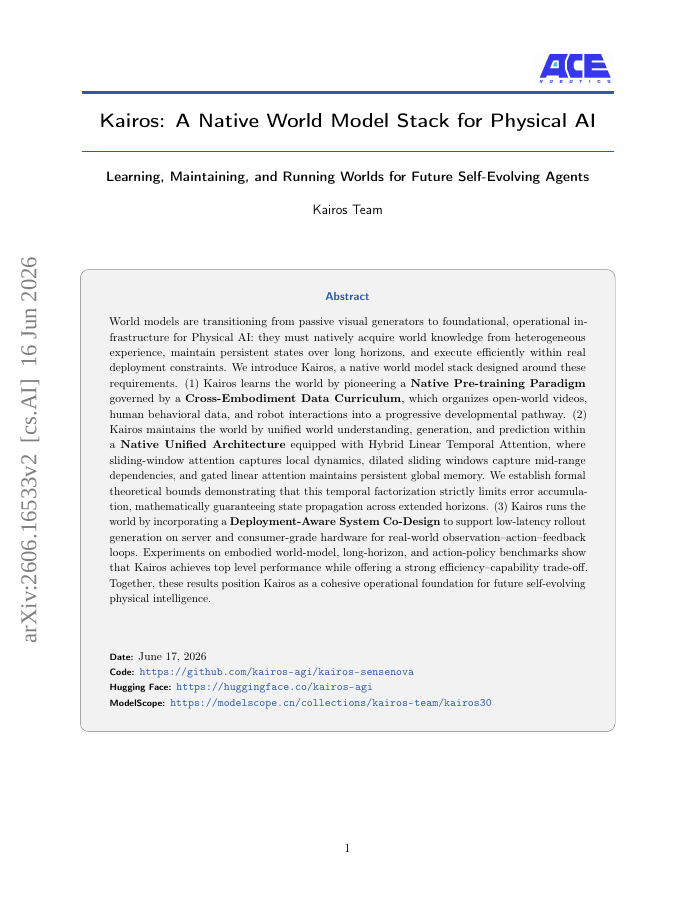
We introduce Kairos, a regret-aware native world-action model stack for Physical AI. Kairos is motivated by the view that a physical world model should not aim to fully simulate all future pixels, but should learn and maintain the information most relevant to embodiment control: object state, spatial relations, contact conditions, task progress, action consequences, failure boundaries, and deployment uncertainty. Kairos establishes three model-side prerequisites toward this goal. First, it learns control-relevant information through a Cross-Embodiment Data Curriculum, which organizes open-world videos, human behavioral data, and robot interactions into an intervention-strength progression from passive physical observation to intentional behavior and embodied action grounding. Second, it maintains control-sufficient states through a unified understanding, generation, and prediction architecture equipped with Hybrid Linear Temporal Attention, where local, mid-range, and global temporal pathways support multi-timescale state maintenance under efficient inference. Third, it deploys these states through a Deployment-Aware System Co-Design, treating latency, memory footprint, and hardware compatibility as first-order constraints for future observation, action, and feedback loops. Experiments on embodied world-model benchmarks, world-action benchmarks, long-horizon generation, and inference-efficiency evaluation show that Kairos achieves superior performance while offering a favorable efficiency to capability trade-off.
Kairos: A Regret-Aware Native World-Action Model Stack for Physical AI
We introduce \textbf{Kairos}, a regret-aware native world-action model stack for Physical AI. Kairos is motivated by the view that a physical world model should not aim to fully simulate all future pixels, but should learn and maintain the information most relevant to embodiment…
- Preview
- Year
- 2026
- Stars
- 3.1k
- Hosting
- Abstract onlyARXIV-DEFAULT
Cite
Notes
Only stored in your browser.
Attribution
- Abstract & full text
- arxiv.org/abs/2606.16533ARXIV-DEFAULT
- TL;DR
- Semantic Scholar