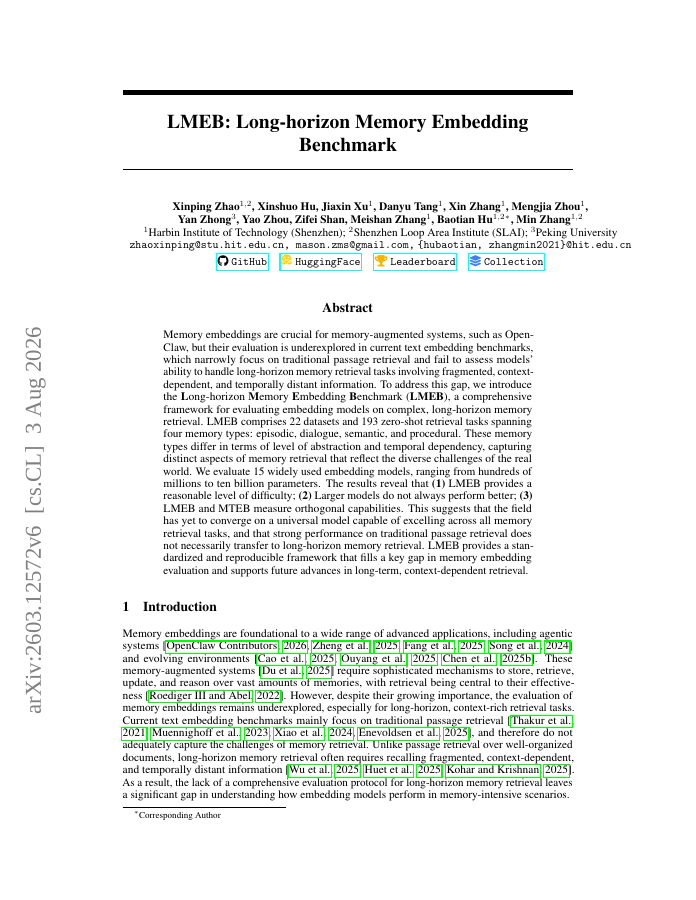
Embedding models are increasingly used as retrievers in memory-augmented systems, but are typically evaluated on traditional passage retrieval benchmarks. It remains unclear whether models that excel at passage retrieval can retrieve fragmented, context-dependent, and temporally distant memories. To address this gap, we introduce the Long-horizon Memory Embedding Benchmark (LMEB), comprising 22 English datasets and 193 zero-shot retrieval tasks across four memory types: episodic, dialogue, semantic, and procedural. We benchmark 30 embedding models ranging from 33M to 12B parameters. We find that no single model dominates across memory types and that evaluation scores on LMEB correlate only weakly with those on the MTEB (English, v2) retrieval subset. These findings underscore the need for benchmarks tailored to long-horizon memory retrieval. LMEB comes with a versatile, open-source evaluation framework and a public leaderboard to guide model selection and advance research on memory embeddings.
LMEB: Long-horizon Memory Embedding Benchmark
Embedding models are increasingly used as retrievers in memory-augmented systems, but are typically evaluated on traditional passage retrieval benchmarks. It remains unclear whether models that excel at passage retrieval can retrieve fragmented, context-dependent, and temporally…
- Preview
- Year
- 2026
- Venue
- arXiv 2026
- Authors
- 12
- Hosting
- Abstract onlyARXIV-DEFAULT
Cite
Notes
Only stored in your browser.
Attribution
- Abstract & full text
- arxiv.org/abs/2603.12572ARXIV-DEFAULT
- TL;DR
- Semantic Scholar