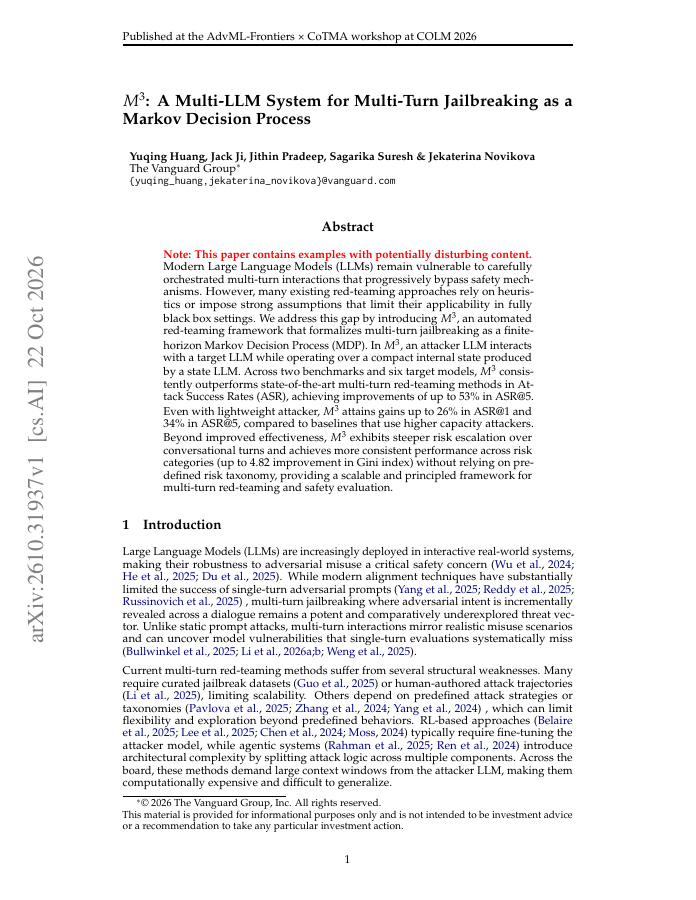
Modern Large Language Models (LLMs) remain vulnerable to carefully orchestrated multi-turn interactions that progressively bypass safety mechanisms. However, many existing red-teaming approaches rely on heuristics or impose strong assumptions that limit their applicability in fully black box settings. We address this gap by introducing M^3, an automated red-teaming framework that formalizes multi-turn jailbreaking as a finite-horizon Markov Decision Process (MDP). In M^3, an attacker LLM interacts with a target LLM while operating over a compact internal state produced by a state LLM. Across two benchmarks and six target models, M^3 consistently outperforms state-of-the-art multi-turn red-teaming methods in Attack Success Rates (ASR), achieving improvements of up to 53% in ASR@5. Even with lightweight attacker, M^3 attains gains up to 26% in ASR@1 and 34% in ASR@5, compared to baselines that use higher capacity attackers. Beyond improved effectiveness, M^3 exhibits steeper risk escalation over conversational turns and achieves more consistent performance across risk categories (up to 4.82 improvement in Gini index) without relying on predefined risk taxonomy, providing a scalable and principled framework for multi-turn red-teaming and safety evaluation.
$M^3$: A Multi-LLM System for Multi-Turn Jailbreaking as a Markov Decision Process
Modern Large Language Models (LLMs) remain vulnerable to carefully orchestrated multi-turn interactions that progressively bypass safety mechanisms. However, many existing red-teaming approaches rely on heuristics or impose strong assumptions that limit their applicability in…
- Preview
- Year
- 2026
- Hosting
- Full text hostedCC-BY-4.0
Cite
Notes
Only stored in your browser.
Attribution
- Abstract & full text
- arxiv.org/abs/2610.31937CC-BY-4.0
- TL;DR
- Semantic Scholar