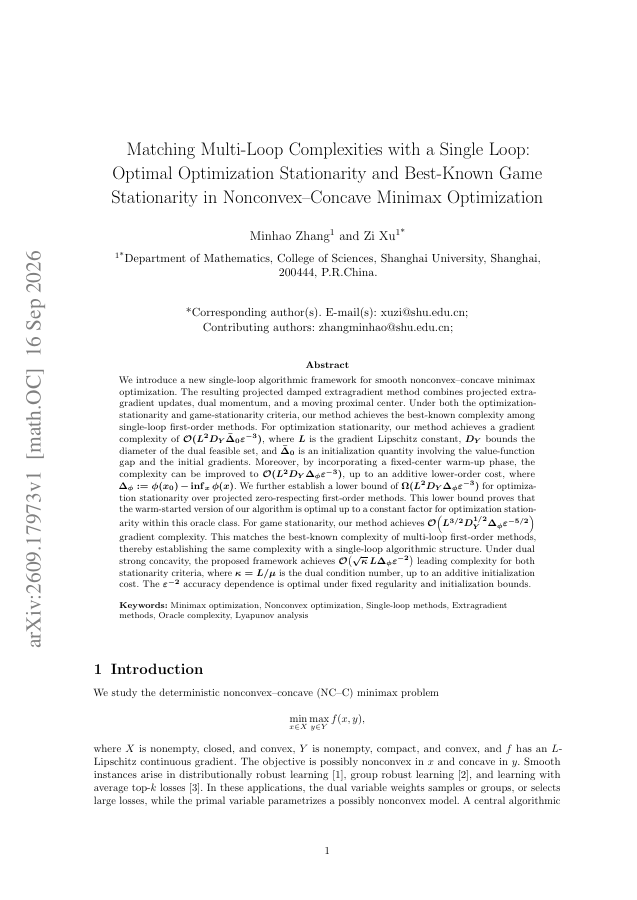
We develop a single-loop first-order framework for smooth nonconvex--concave minimax optimization, with matching leading-order upper and lower bounds for optimization and game stationarity in a projected zero-respecting oracle model. We propose a single-loop projected damped extragradient method coupling projected extragradient updates with dual momentum and a moving proximal center. Each iteration uses at most three gradient evaluations, without nested subproblems. For game stationarity, a deterministic best iterate has first-order residual below \varepsilon with leading oracle complexity O(L^{3/2}D_Y^{1/2}Δ_ϕ\varepsilon^{-5/2}), where L is the gradient Lipschitz constant, D_Y bounds the dual feasible-set diameter, and Δ_ϕ is the initial-point-dependent value-function gap. For optimization stationarity, a uniformly selected iterate has expected squared Moreau-envelope gradient norm at most \varepsilon^2 with leading oracle complexity O(L^2D_YΔ_ϕ\varepsilon^{-3}). Matching lower bounds are Ω(L^{3/2}D_Y^{1/2}Δ_ϕ\varepsilon^{-5/2}) for game stationarity and Ω(L^2D_YΔ_ϕ\varepsilon^{-3}) for optimization stationarity over projected zero-respecting first-order methods. Under dual strong concavity, the same framework achieves leading first-order oracle complexity O(\sqrtκLΔ_ϕ\varepsilon^{-2}) under both criteria, where κ is the dual condition number. Matching lower bounds hold for both criteria in the same oracle model. To our knowledge, this is the first work to close the oracle complexity gap for smooth nonconvex--concave minimax optimization under both stationarity criteria by simultaneously improving upper and lower bounds in the projected zero-respecting oracle model.
A Single-Loop Method with Optimal Leading-Order Oracle Complexity for Optimization and Game Stationarity in Nonconvex--Concave Minimax Optimization
We develop a single-loop first-order framework for smooth nonconvex--concave minimax optimization, with matching leading-order upper and lower bounds for optimization and game stationarity in a projected zero-respecting oracle model.
- Preview
- Year
- 2026
- Hosting
- Abstract onlyARXIV-DEFAULT
Cite
Notes
Only stored in your browser.
Attribution
- Abstract & full text
- arxiv.org/abs/2609.17973ARXIV-DEFAULT
- TL;DR
- Semantic Scholar