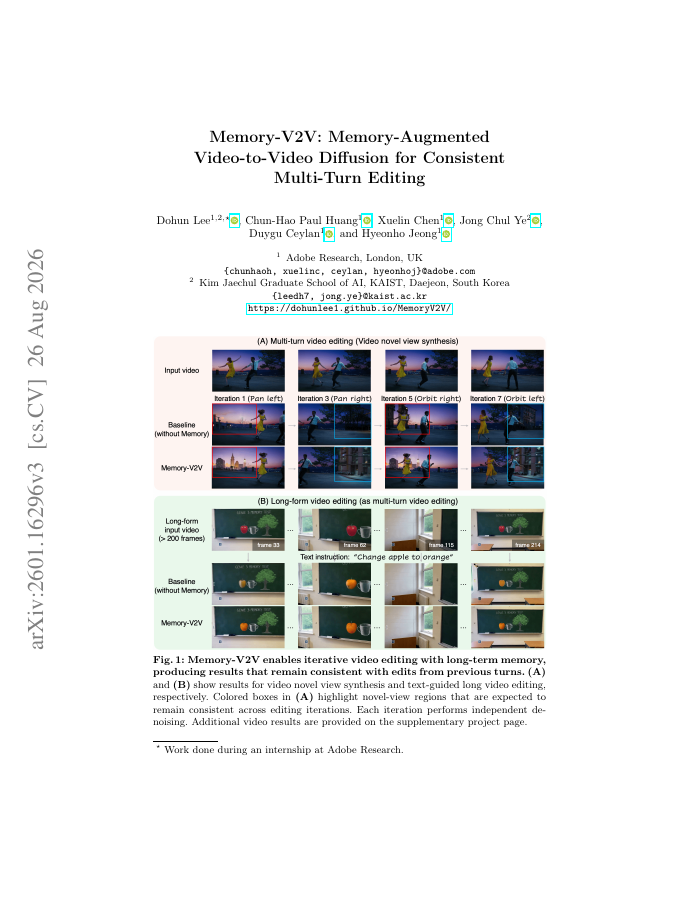
Video-to-video diffusion models achieve impressive single-turn editing performance, but practical editing workflows are inherently iterative. When edits are applied sequentially, existing models treat each turn independently, often causing previously generated regions to drift or be overwritten. We identify this failure mode as the problem of cross-turn consistency in multi-turn video editing. We introduce Memory-V2V, a memory-augmented framework that treats prior edits as structured constraints for subsequent generations. Memory-V2V maintains an external memory of previous outputs, retrieves task-relevant edits, and integrates them through relevance-aware tokenization and adaptive compression. These technical ingredients enable scalable conditioning without linear growth in computation. We demonstrate Memory-V2V on iterative video novel view synthesis and text-guided long video editing. Memory-V2V substantially enhances cross-turn consistency while maintaining visual quality, outperforming strong baselines with modest overhead.
Memory-V2V: Memory-Augmented Video-to-Video Diffusion for Consistent Multi-Turn Editing
Video-to-video diffusion models achieve impressive single-turn editing performance, but practical editing workflows are inherently iterative. When edits are applied sequentially, existing models treat each turn independently, often causing previously generated regions to drift…
- Preview
- Year
- 2026
- Venue
- arXiv 2026
- Authors
- 6
- Hosting
- Full text hostedCC-BY-4.0
Cite
Notes
Only stored in your browser.
Attribution
- Abstract & full text
- arxiv.org/abs/2601.16296CC-BY-4.0
- TL;DR
- Semantic Scholar