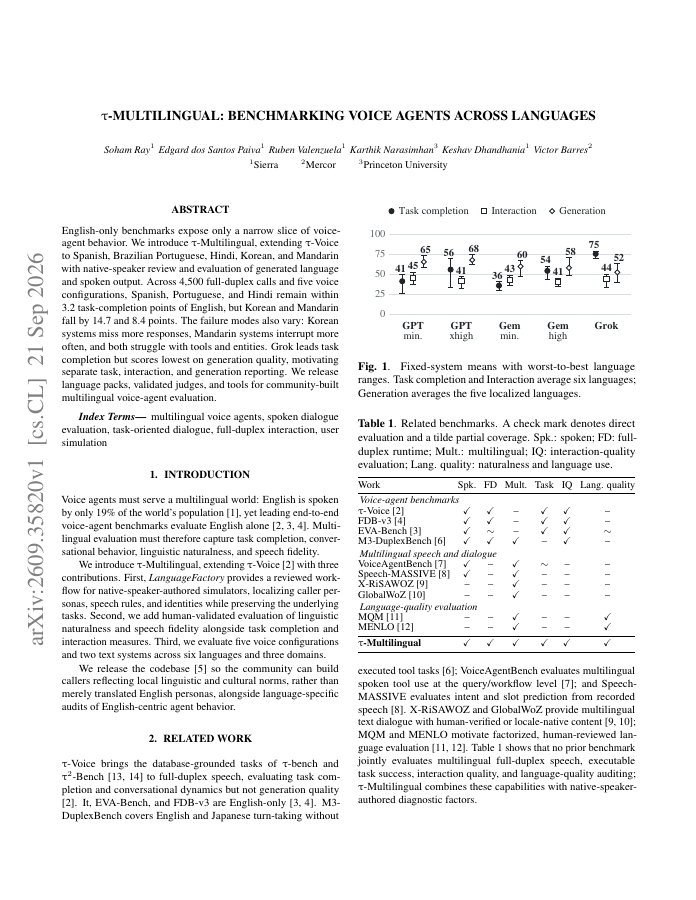
English-only benchmarks expose only a narrow slice of voice-agent behavior. We introduce τ-Multilingual, extending τ-Voice to Spanish, Brazilian Portuguese, Hindi, Korean, and Mandarin with native-speaker review and evaluation of generated language and spoken output. Across 4,500 full-duplex calls and five voice configurations, Spanish, Portuguese, and Hindi remain within 3.2 task-completion points of English, but Korean and Mandarin fall by 14.7 and 8.4 points. The failure modes also vary: Korean systems miss more responses, Mandarin systems interrupt more often, and both struggle with tools and entities. Grok leads task completion but scores lowest on generation quality, motivating separate task, interaction, and generation reporting. We release language packs, validated judges, and tools for community-built multilingual voice-agent evaluation.
$τ$-Multilingual: Benchmarking Voice Agents Across Languages
English-only benchmarks expose only a narrow slice of voice-agent behavior. We introduce $τ$-Multilingual, extending $τ$-Voice to Spanish, Brazilian Portuguese, Hindi, Korean, and Mandarin with native-speaker review and evaluation of generated language and spoken output.
- Preview
- Year
- 2026
- Hosting
- Full text hostedCC-BY-4.0
Cite
Notes
Only stored in your browser.
Attribution
- Abstract & full text
- arxiv.org/abs/2609.35820CC-BY-4.0
- TL;DR
- Semantic Scholar