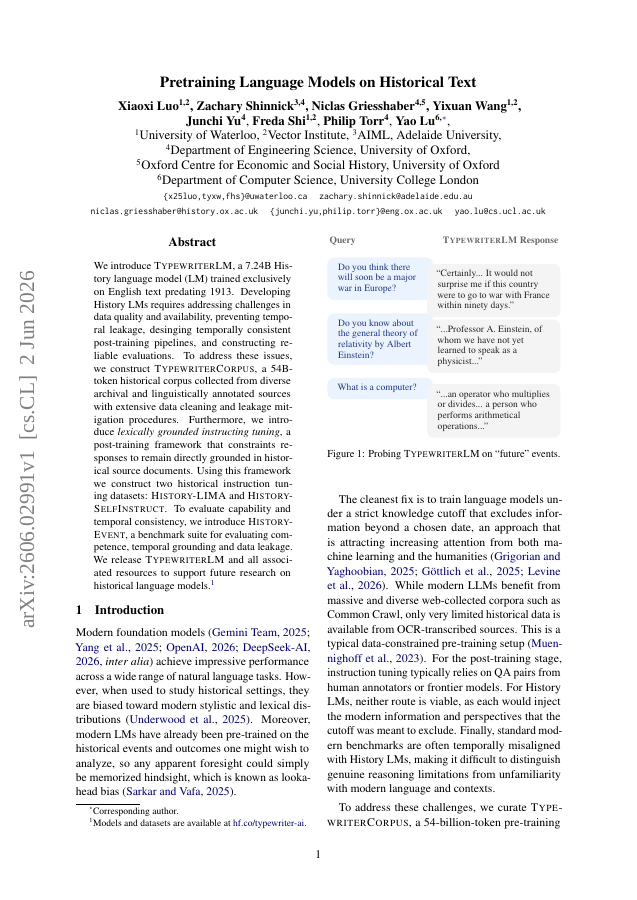
While modern language models increasingly rely on ever-larger web corpora, we show that pretraining on historical text (e.g., pre-1913 text) in a data-constrained setting can produce a temporally grounded language model that still shows reasonable performance on language understanding. However, developing History LMs requires addressing challenges in data quality, preventing temporal leakage in post-training, and constructing temporally aligned evaluations. We address these challenges and pretrain TypewriterLM, a 7.24B-parameter model with a 1913 knowledge cutoff. We construct TypewriterCorpus, a 54B-token historical corpus with extensive temporal filtering, propose lexically grounded instruction tuning that constrains all responses to vocabulary from historical source documents, and introduce History-Event, a benchmark of 2,344 events for evaluating both competence and cutoff adherence. We release TypewriterLM and all associated resources to support future research on History LMs.
A Language Model from 1913: Pretraining on Historical Text
While modern language models increasingly rely on ever-larger web corpora, we show that pretraining on historical text (e.g., pre-1913 text) in a data-constrained setting can produce a temporally grounded language model that still shows reasonable performance on language…
- Preview
- Year
- 2026
- Hosting
- Full text hostedCC-BY-4.0
Cite
Notes
Only stored in your browser.
Attribution
- Abstract & full text
- arxiv.org/abs/2606.02991CC-BY-4.0
- TL;DR
- Semantic Scholar