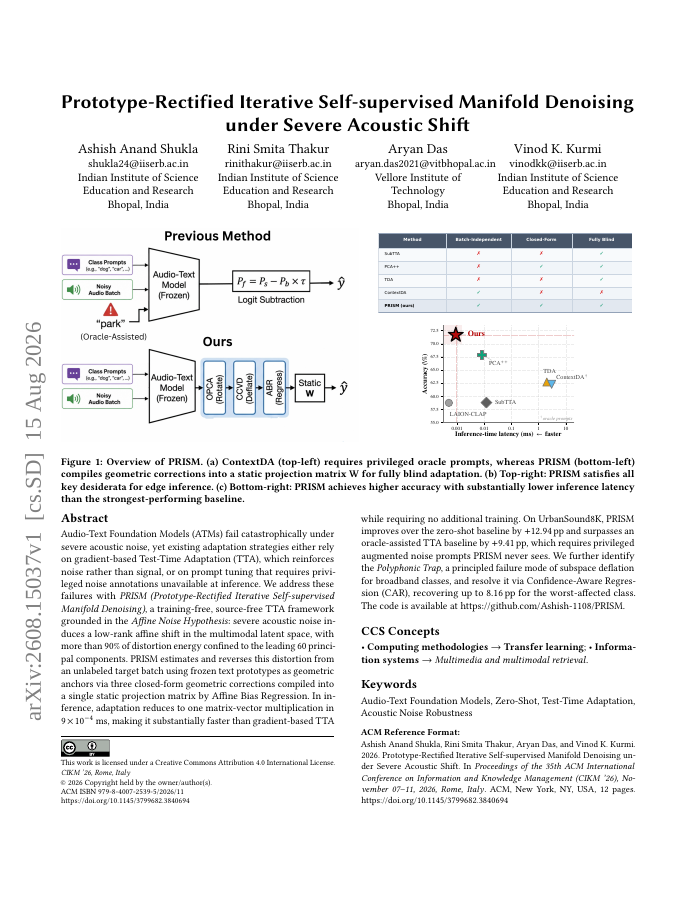
Audio-Text Foundation Models (ATMs) fail catastrophically under severe acoustic noise, yet existing adaptation strategies either rely on gradient-based Test-Time Adaptation (TTA), which reinforces noise rather than signal, or on prompt tuning that requires privileged noise annotations unavailable at inference. We address these failures with PRISM (Prototype-Rectified Iterative Self-supervised Manifold Denoising), a training-free, source-free TTA framework grounded in the Affine Noise Hypothesis: severe acoustic noise induces a low-rank affine shift in the multimodal latent space, with more than 90% of distortion energy confined to the leading 60 principal components. PRISM estimates and reverses this distortion from an unlabeled target batch using frozen text prototypes as geometric anchors via three closed-form geometric corrections compiled into a single static projection matrix by Affine Bias Regression. At inference, adaptation reduces to one matrix-vector multiplication in 0.0009 ms, making it substantially faster than gradient-based TTA while requiring no additional training. On UrbanSound8K, PRISM improves over the zero-shot baseline by 12.94 percentage points and surpasses an oracle-assisted TTA baseline by 9.41 percentage points, despite never observing its privileged augmented noise prompts. We further identify the Polyphonic Trap, a principled failure mode of subspace deflation for broadband classes, and resolve it via Confidence-Aware Regression (CAR), recovering up to 8.16 percentage points for the worst-affected class.
Prototype-Rectified Iterative Self-supervised Manifold Denoising under Severe Acoustic Shift
Audio-Text Foundation Models (ATMs) fail catastrophically under severe acoustic noise, yet existing adaptation strategies either rely on gradient-based Test-Time Adaptation (TTA), which reinforces noise rather than signal, or on prompt tuning that requires privileged noise…
- Preview
- Year
- 2026
- Stars
- 2
- Hosting
- Full text hostedCC-BY-4.0
Cite
Notes
Only stored in your browser.
Attribution
- Abstract & full text
- arxiv.org/abs/2608.15037CC-BY-4.0
- TL;DR
- Semantic Scholar