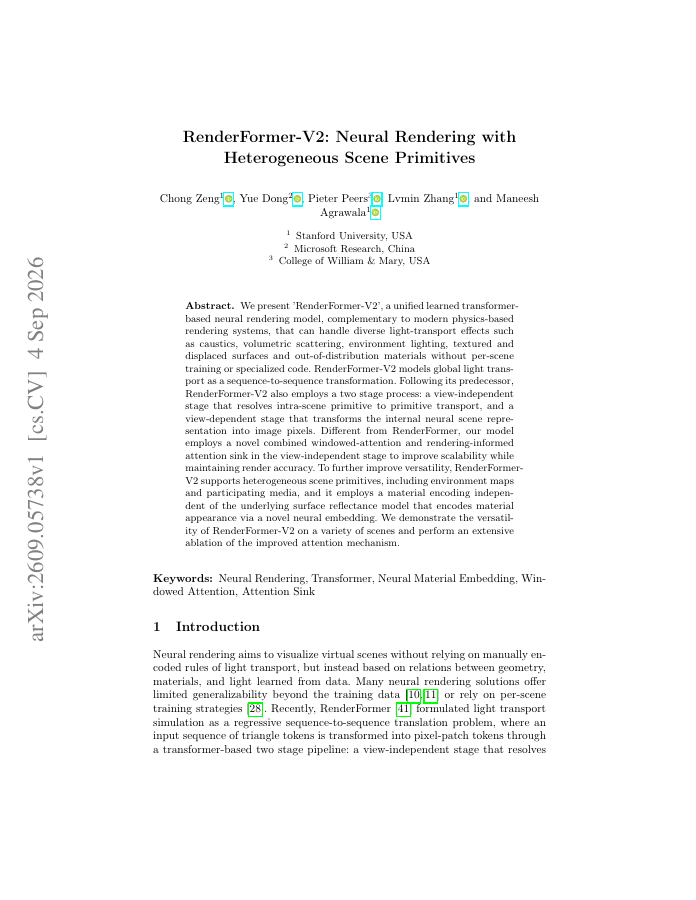
We present 'RenderFormer-V2', a unified learned transformer-based neural rendering model, complementary to modern physics-based rendering systems, that can handle diverse light-transport effects such as caustics, volumetric scattering, environment lighting, textured and displaced surfaces and out-of-distribution materials without per-scene training or specialized code. RenderFormer-V2 models global light transport as a sequence-to-sequence transformation. Following its predecessor, RenderFormer-V2 also employs a two stage process: a view-independent stage that resolves intra-scene primitive to primitive transport, and a view-dependent stage that transforms the internal neural scene representation into image pixels. Different from RenderFormer, our model employs a novel combined windowed-attention and rendering-informed attention sink in the view-independent stage to improve scalability while maintaining render accuracy. To further improve versatility, RenderFormerV2 supports heterogeneous scene primitives, including environment maps and participating media, and it employs a material encoding independent of the underlying surface reflectance model that encodes material appearance via a novel neural embedding. We demonstrate the versatility of RenderFormer-V2 on a variety of scenes and perform an extensive ablation of the improved attention mechanism.
RenderFormer-V2: Neural Rendering with Heterogeneous Scene Primitives
We present 'RenderFormer-V2', a unified learned transformer-based neural rendering model, complementary to modern physics-based rendering systems, that can handle diverse light-transport effects such as caustics, volumetric scattering, environment lighting, textured and…
- Preview
- Year
- 2026
- Stars
- 23
- Hosting
- Abstract onlyARXIV-DEFAULT
Cite
Notes
Only stored in your browser.
Attribution
- Abstract & full text
- arxiv.org/abs/2609.05738ARXIV-DEFAULT
- TL;DR
- Semantic Scholar