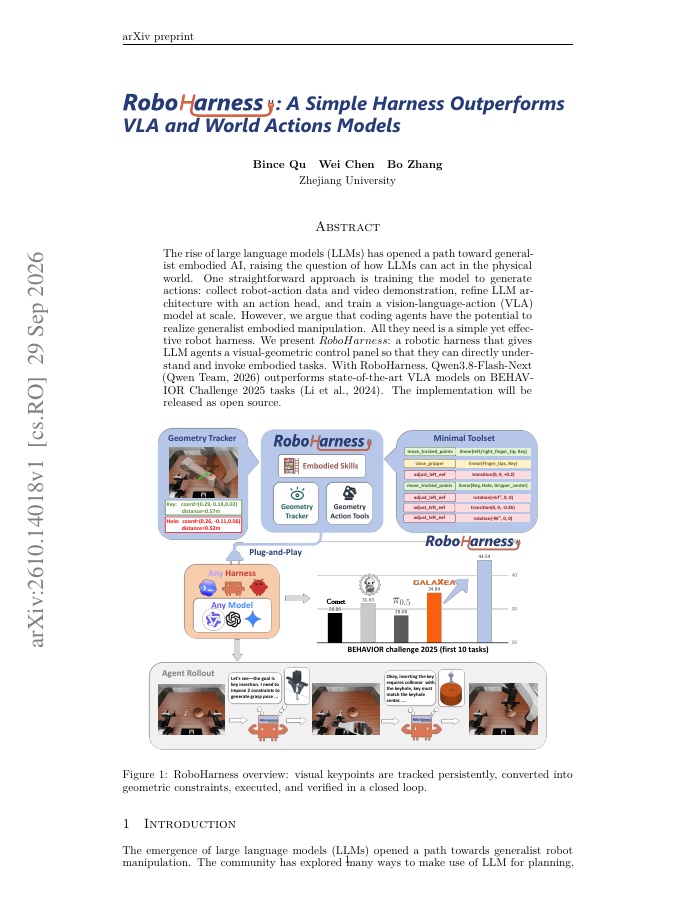
The rise of large language models (LLMs) has opened a path toward generalist embodied AI, raising the question of how LLMs can act in the physical world. One straightforward approach is training the model to generate actions: collect robot-action data and video demonstration, refine LLM architecture with an action head, and train a vision-language-action (VLA) model at scale. However, we argue that coding agents have the potential to realize generalist embodied manipulation. All they need is a simple yet effective robot harness. We present RoboHarness: a robotic harness that gives LLM agents a visual-geometric control panel so that they can directly understand and invoke embodied tasks. With RoboHarness, Qwen3.8-Flash-Next outperforms state-of-the-art VLA models on BEHAVIOR Challenge 2025 tasks. The implementation is open source.
RoboHarness: A Simple Harness Outperforms VLA and World Action Models
The rise of large language models (LLMs) has opened a path toward generalist embodied AI, raising the question of how LLMs can act in the physical world. One straightforward approach is training the model to generate actions: collect robot-action data and video demonstration,…
- Preview
- Year
- 2026
- Stars
- 268
- Hosting
- Abstract onlyARXIV-DEFAULT
Cite
Notes
Only stored in your browser.
Attribution
- Abstract & full text
- arxiv.org/abs/2610.14018ARXIV-DEFAULT
- TL;DR
- Semantic Scholar