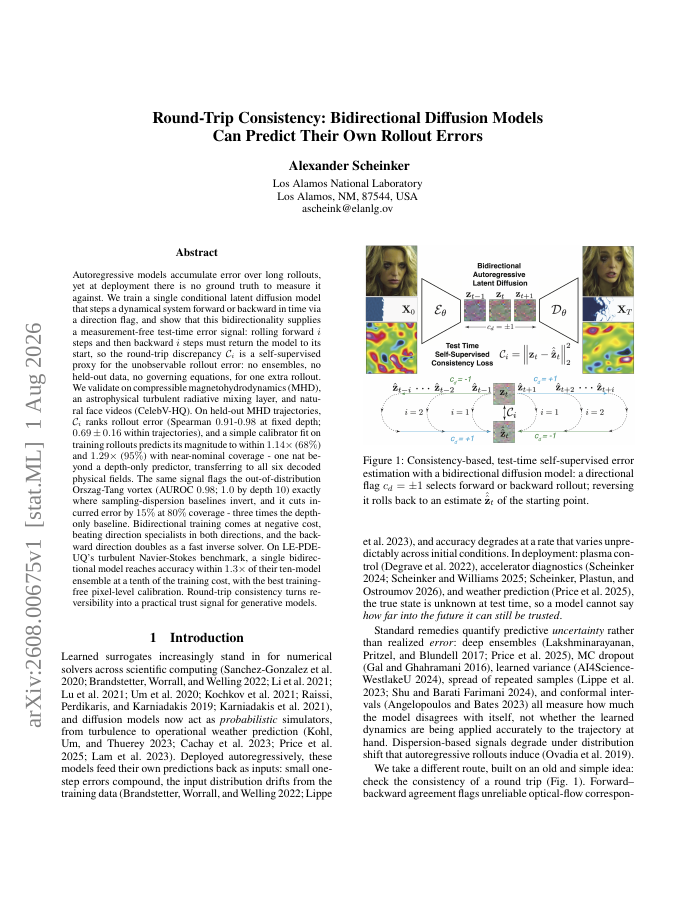
Autoregressive models accumulate error over long rollouts, yet at deployment there is no ground truth to measure it against. We train a single conditional latent diffusion model that steps a dynamical system forward or backward in time via a direction flag, and show that this bidirectionality supplies a measurement-free test-time error signal: rolling forward i steps and then backward i steps must return the model to its start, so the round-trip discrepancy C_i is a self-supervised proxy for the unobservable rollout error: no ensembles, no held-out data, no governing equations, for one extra rollout. We validate on compressible magnetohydrodynamics (MHD), an astrophysical turbulent radiative mixing layer, and natural face videos (CelebV-HQ). On held-out MHD trajectories, C_i ranks rollout error (Spearman 0.91-0.98 at fixed depth; 0.69 \pm 0.16 within trajectories), and a simple calibrator fit on training rollouts predicts its magnitude to within 1.14\times (68%) and 1.29\times (95%) with near-nominal coverage - one nat beyond a depth-only predictor, transferring to all six decoded physical fields. The same signal flags the out-of-distribution Orszag-Tang vortex (AUROC 0.98; 1.0 by depth 10) exactly where sampling-dispersion baselines invert, and it cuts incurred error by 15% at 80% coverage - three times the depth-only baseline. Bidirectional training comes at negative cost, beating direction specialists in both directions, and the backward direction doubles as a fast inverse solver. On LE-PDE-UQ's turbulent Navier-Stokes benchmark, a single bidirectional model reaches accuracy within 1.3\times of their ten-model ensemble at a tenth of the training cost, with the best training-free pixel-level calibration. Round-trip consistency turns reversibility into a practical trust signal for generative models.
Round-Trip Consistency: Bidirectional Diffusion Models Can Predict Their Own Rollout Errors
Autoregressive models accumulate error over long rollouts, yet at deployment there is no ground truth to measure it against. We train a single conditional latent diffusion model that steps a dynamical system forward or backward in time via a direction flag, and show that this…
- Preview
- Year
- 2026
- Stars
- 11
- Hosting
- Abstract onlyARXIV-DEFAULT
Cite
Notes
Only stored in your browser.
Attribution
- Abstract & full text
- arxiv.org/abs/2608.00675ARXIV-DEFAULT
- TL;DR
- Semantic Scholar