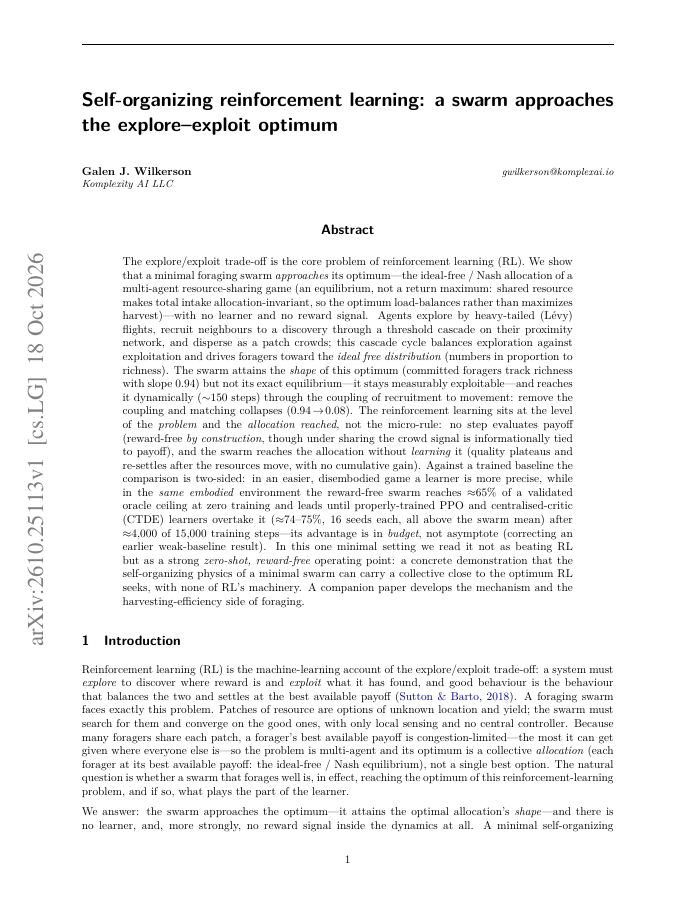
The explore-exploit trade-off is the core problem of reinforcement learning (RL). In its multi-agent, resource-sharing form the optimum is not a scalar-return maximum but an equilibrium allocation -- the ideal-free distribution (IFD), the Nash equilibrium of a congestion game. We show that a minimal foraging swarm reaches the shape of this equilibrium as a self-organized attractor -- foragers in proportion to resource richness (matching slope 0.94) -- with no learner, no trained parameters, and no payoff or reward read anywhere in its dynamics. Agents explore by heavy-tailed (Levy) flights, recruit neighbours to a discovery through a threshold cascade on their proximity network, and disperse as a patch crowds; removing the coupling of recruitment to movement collapses the matching (slope 0.08). The reinforcement learning is at the level of the problem and the allocation reached, not the micro-rule. The swarm reaches this equilibrium rather than learning it, attaining its shape but not the exact equilibrium: it stays measurably exploitable (Nash-gap 0.58 versus 0.01 for a converged learner). Against PPO learners (feedforward, centralized-critic, and graph message-passing) trained in the same sensing-limited environment, the reward-free swarm at zero training matches the IFD gradient more faithfully than any learner (slope 1 vs 0.69-0.91) and ties the best learner's harvest where clustered (both plateau at 0.80 of an oracle ceiling), while the learner collects more where resource is scarce (0.33 vs 0.22) and holds tighter per-capita intake. Learning thus buys precision and transfer, not a better allocation; neither message passing nor a centralized critic exceeds it at this budget. We read this not as beating RL, but as evidence that a minimal swarm's physics reaches the equilibrium RL seeks without a learner, a reward, or a trained parameter. A companion paper develops the mechanism.
A learner-free swarm reaches the explore-exploit equilibrium: A self-organized attractor approximating the reinforcement-learning solution
The explore-exploit trade-off is the core problem of reinforcement learning (RL). In its multi-agent, resource-sharing form the optimum is not a scalar-return maximum but an equilibrium allocation -- the ideal-free distribution (IFD), the Nash equilibrium of a congestion game.
- Preview
- Year
- 2026
- Hosting
- Abstract onlyARXIV-DEFAULT
Cite
Notes
Only stored in your browser.
Attribution
- Abstract & full text
- arxiv.org/abs/2610.25113ARXIV-DEFAULT
- TL;DR
- Semantic Scholar