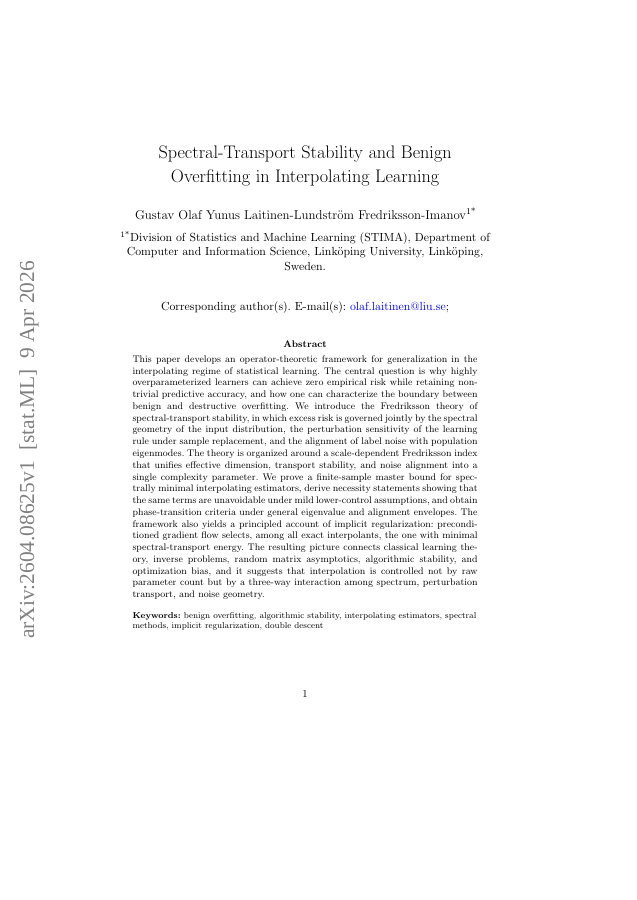
Benign overfitting, the phenomenon that interpolating noisy data can be statistically harmless, is usually characterized through effective-rank conditions on the covariance spectrum. These conditions are fragile: a perturbation of vanishing relative operator and Frobenius norm can turn a benign covariance into one whose minimum-norm interpolator has non-vanishing excess risk. We argue that the natural geometry of benign overfitting is optimal transport of the log-eigenvalues, measured in units of the sample size n. In log-spectral coordinates, the deterministic equivalent of the risk becomes a functional of two measures smoothed by a logistic kernel centred at the interpolation threshold \logκ. We compute its exact first variation: the threshold moves by a sensitivity-weighted average of the log-eigenvalue displacements, and the influence of each eigenvalue decays exponentially with its log-distance to the threshold. We then derive global, dimension-free stability bounds. The variance functional is 8/(27n)-Lipschitz in the 1-Wasserstein distance between log-spectra, with a sharp constant, and is controlled more generally by a threshold-localized transport discrepancy; an analogous bound controls the bias. Consequently, any rank-k update of the covariance, of arbitrary norm, changes the variance functional by at most 3k/n, and benign overfitting survives every perturbation whose localized transport cost is o(n). The results extend to ridge regression and to infinite-dimensional trace-class covariances. Matching lower bounds show that the n-scaling is necessary and cannot be replaced by operator norms, Frobenius norms, or dimension-normalized spectral distances. Simulations, one-step feature learning in two-layer networks, and random features of real images support the theory and delineate its limits.
A Transport Geometry of Benign Overfitting
Benign overfitting, the phenomenon that interpolating noisy data can be statistically harmless, is usually characterized through effective-rank conditions on the covariance spectrum.
- Preview
- Year
- 2026
- Hosting
- Full text hostedCC-BY-4.0
Cite
Notes
Only stored in your browser.
Attribution
- Abstract & full text
- arxiv.org/abs/2604.08625CC-BY-4.0
- TL;DR
- Semantic Scholar