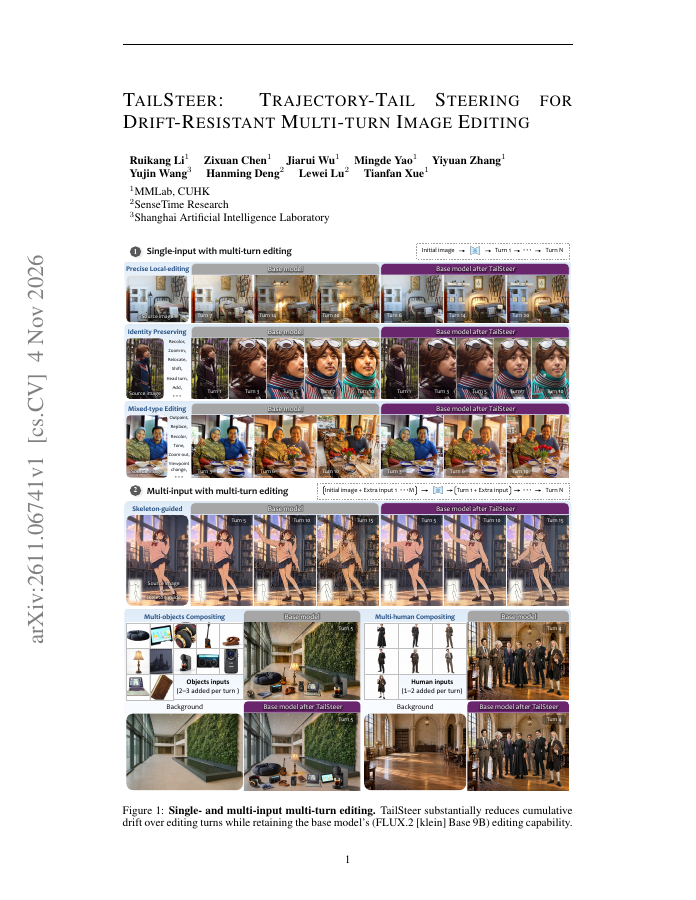
Strong single-turn editing performance does not guarantee reliable multi-turn interaction: as edited outputs are repeatedly reused, small unintended changes can accumulate into severe visual drift. This long-term drift is often mitigated through training on multi-turn data or cross-turn rollouts, potentially altering pretrained priors, or through specialized inference-time mechanisms that are difficult to scale to foundation models. We introduce TailSteer, a final-stage training framework that improves multi-turn robustness while retaining the generative and editing capabilities acquired through earlier training. TailSteer follows a simple principle: keep early denoising dynamics close to those of the base model and concentrate preservation corrections near the trajectory tail, where fine-grained deviations can be suppressed. These corrections are learned from the editor's own on-policy denoising rollouts, using unchanged source content as a preservation reference without requiring curated ground-truth editing pairs. Experiments across the FLUX, SenseNova, and Qwen families show that TailSteer substantially reduces cumulative drift over 15-20 editing turns while largely preserving base-model performance on extensive text-to-image and single-image editing benchmarks. These results demonstrate that long-horizon editing robustness can be unlocked in foundation models after TailSteer, rather than by relearning their existing capabilities.
TailSteer: Trajectory-Tail Steering for Drift-Resistant Multi-turn Image Editing
Strong single-turn editing performance does not guarantee reliable multi-turn interaction: as edited outputs are repeatedly reused, small unintended changes can accumulate into severe visual drift.
- Preview
- Year
- 2026
- Stars
- 59
- Hosting
- Excerpt onlyCC-BY-NC-SA-4.0
Cite
Notes
Only stored in your browser.
Attribution
- Abstract & full text
- arxiv.org/abs/2611.06741CC-BY-NC-SA-4.0
- TL;DR
- Semantic Scholar