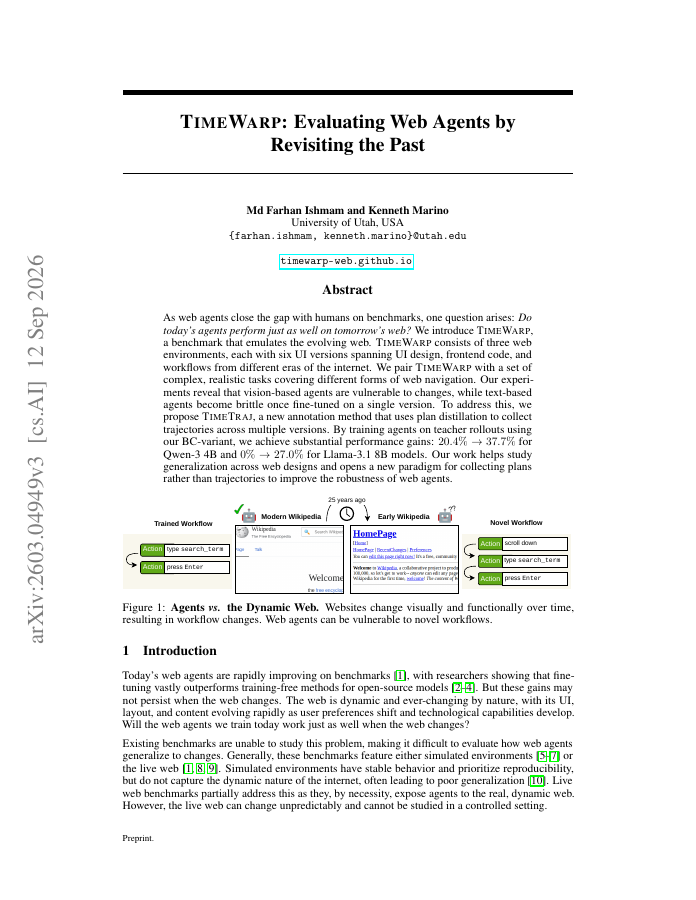
As web agents close the gap with humans on benchmarks, one question arises: Do today's agents perform just as well on tomorrow's web? We introduce TimeWarp, a benchmark that emulates the evolving web. TimeWarp consists of three web environments, each with six UI versions spanning UI design, frontend code, and workflows from different eras of the internet. We pair TimeWarp with a set of complex, realistic tasks covering different forms of web navigation. Our experiments reveal that vision-based agents are vulnerable to changes, while text-based agents become brittle once fine-tuned on a single version. To address this, we propose TimeTraj, a new annotation method that uses plan distillation to collect trajectories across multiple versions. By training agents on teacher rollouts using our BC-variant, we achieve substantial performance gains: 20.4% to 37.7% for Qwen-3 4B and 0% to 27.0% for Llama-3.1 8B models. Our work helps study generalization across web designs and opens a new paradigm for collecting plans rather than trajectories to improve the robustness of web agents.
TimeWarp: Evaluating Web Agents by Revisiting the Past
As web agents close the gap with humans on benchmarks, one question arises: Do today's agents perform just as well on tomorrow's web? We introduce TimeWarp, a benchmark that emulates the evolving web.
- Preview
- Year
- 2026
- Venue
- arXiv 2026
- Authors
- 2
- Hosting
- Full text hostedCC-BY-4.0
Cite
Notes
Only stored in your browser.
Attribution
- Abstract & full text
- arxiv.org/abs/2603.04949CC-BY-4.0
- TL;DR
- Semantic Scholar