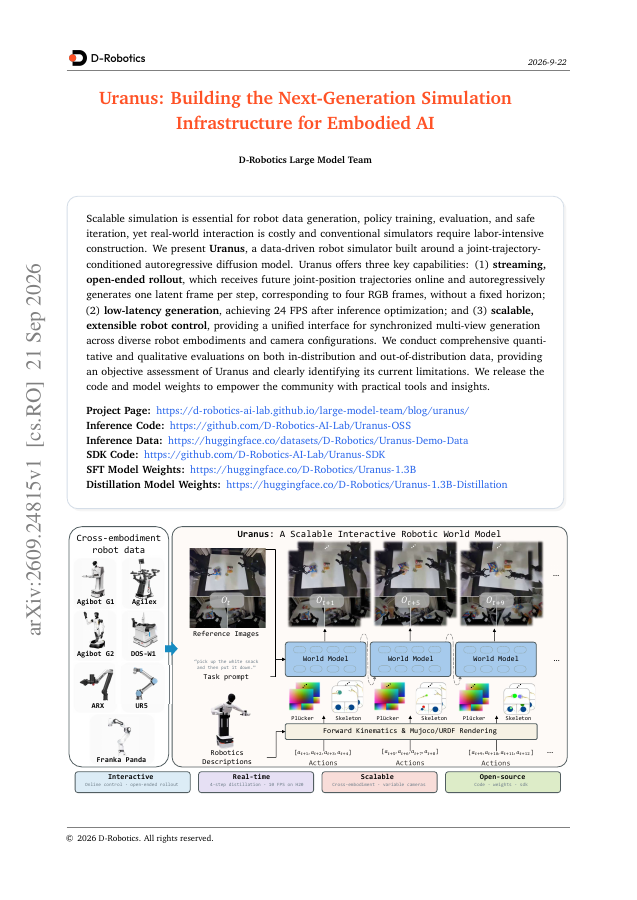
Scalable simulation is essential for robot data generation, policy training, evaluation, and safe iteration, yet real-world interaction is costly and conventional simulators require labor-intensive construction. We present Uranus, a data-driven robot simulator built around a joint-trajectory-conditioned autoregressive diffusion model. Uranus offers three key capabilities: (1) streaming, open-ended rollout, which receives future joint-position trajectories online and autoregressively generates one latent frame per step, corresponding to four RGB frames, without a fixed horizon; (2) low-latency generation, achieving 24 FPS after inference optimization; and (3) scalable, extensible robot control, providing a unified interface for synchronized multi-view generation across diverse robot embodiments and camera configurations. We conduct comprehensive quantitative and qualitative evaluations on both in-distribution and out-of-distribution data, providing an objective assessment of Uranus and clearly identifying its current limitations. We release the code and model weights to empower the community with practical tools and insights.
Uranus: Building the Next-Generation Simulation Infrastructure for Embodied AI
Scalable simulation is essential for robot data generation, policy training, evaluation, and safe iteration, yet real-world interaction is costly and conventional simulators require labor-intensive construction.
- Preview
- Year
- 2026
- Stars
- 4
- Hosting
- Abstract onlyARXIV-DEFAULT
Cite
Notes
Only stored in your browser.
Attribution
- Abstract & full text
- arxiv.org/abs/2609.24815ARXIV-DEFAULT
- TL;DR
- Semantic Scholar