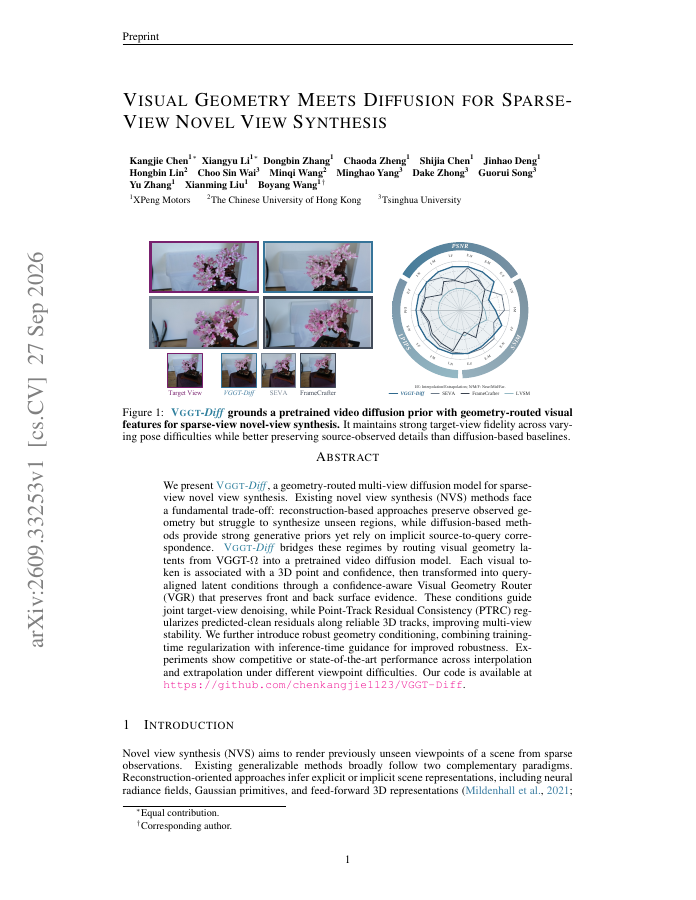
We present VGGT-Diff, a geometry-routed multi-view diffusion model for sparse-view novel view synthesis. Existing novel view synthesis (NVS) methods face a fundamental trade-off: reconstruction-based approaches preserve observed geometry but struggle to synthesize unseen regions, while diffusion-based methods provide strong generative priors yet rely on implicit source-to-query correspondence. VGGT-Diff bridges these regimes by routing visual geometry latents from VGGT-Ω into a pretrained video diffusion model. Each visual token is associated with a 3D point and confidence, then transformed into query-aligned latent conditions through a confidence-aware Visual Geometry Router (VGR) that preserves front and back surface evidence. These conditions guide joint target-view denoising, while Point-Track Residual Consistency (PTRC) regularizes predicted-clean residuals along reliable 3D tracks, improving multi-view stability. We further introduce robust geometry conditioning, combining training-time regularization with inference-time guidance for improved robustness. Experiments show competitive or state-of-the-art performance across interpolation and extrapolation under different viewpoint difficulties. Our code is available at https://github.com/chenkangjie1123/VGGT-Diff.
VGGT-Diff: Visual Geometry Meets Diffusion for Sparse-View Novel View Synthesis
We present VGGT-Diff, a geometry-routed multi-view diffusion model for sparse-view novel view synthesis. Existing novel view synthesis (NVS) methods face a fundamental trade-off: reconstruction-based approaches preserve observed geometry but struggle to synthesize unseen…
- Preview
- Year
- 2026
- Stars
- 49
- Hosting
- Abstract onlyARXIV-DEFAULT
Cite
Notes
Only stored in your browser.
Attribution
- Abstract & full text
- arxiv.org/abs/2609.33253ARXIV-DEFAULT
- TL;DR
- Semantic Scholar