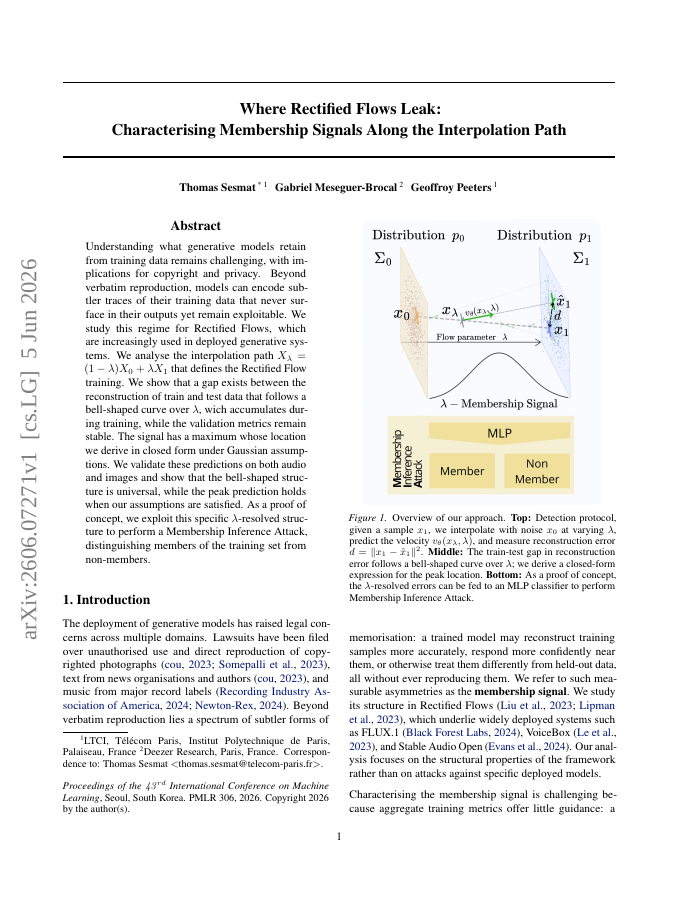
Understanding memorization in generative models remains challenging, with implications for copyright and privacy. Beyond verbatim reproduction, models can encode subtler traces of their training data that never surface in their outputs yet remain exploitable. We refer to these measurable asymmetries as the membership signal, and we study this regime for Flow Matching, which are increasingly used in deployed generative systems. We analyze the linear interpolation path X_λ= (1-λ)X_0 + λX_1 that defines standard Flow Matching training. We show that a gap exists between the reconstruction of train and test data that follows a bell-shaped curve over λ, which accumulates during training, while the validation metrics remain stable. The signal has a maximum whose location we derive in closed form under Gaussian assumptions. We validate these predictions on both audio and images and show that the bell-shaped structure is universal, while the peak prediction holds when our assumptions are satisfied. As a proof of concept, we exploit this specific λ-resolved structure to perform a Membership Inference Attack, distinguishing members of the training set from non-members.
Where Flow Matching Leaks: Characterising Membership Signals Along the Interpolation Path
Understanding memorization in generative models remains challenging, with implications for copyright and privacy. Beyond verbatim reproduction, models can encode subtler traces of their training data that never surface in their outputs yet remain exploitable.
- Preview
- Year
- 2026
- Stars
- 0
- Hosting
- Full text hostedCC-BY-4.0
Cite
Notes
Only stored in your browser.
Attribution
- Abstract & full text
- arxiv.org/abs/2606.07271CC-BY-4.0
- TL;DR
- Semantic Scholar