12 Nov 2026
Choosing robot model capacity and demonstration budgets also requires decisions about data composition, representation, optimization, and deployment. We connect these decisions through a common conditional-distribution target.
Trending research and the full catalog - each paper linked to the benchmarks, methods, and models it introduces.
Filtering here covers the 2,000 most recent papers, as much as one page can hold in memory. See the full index of 23,060 papers.
12 Nov 2026
Choosing robot model capacity and demonstration budgets also requires decisions about data composition, representation, optimization, and deployment. We connect these decisions through a common conditional-distribution target.
12 Nov 2026
Assessing the external validity of experimental results is a pervasive challenge in causal inference as internally valid findings need not generalize beyond sites in which the experiments were conducted.
12 Nov 2026
Causal discovery promises to find which recorded variables drive a process target such as product quality, yield or energy use. Process data with known causes are rare, and in existing benchmarks the difficulty of identifying the causes of a target is either fixed by the…
11 Nov 2026
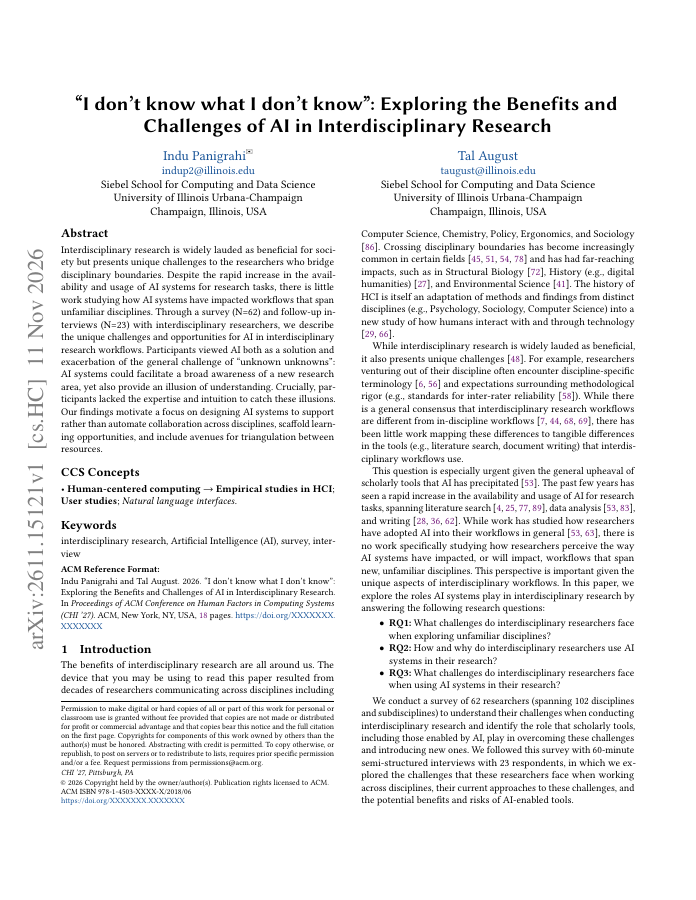
Interdisciplinary research is widely lauded as beneficial for society but presents unique challenges to the researchers who bridge disciplinary boundaries. Despite the rapid increase in the availability and usage of AI systems for research tasks, there is little work studying…
11 Nov 2026
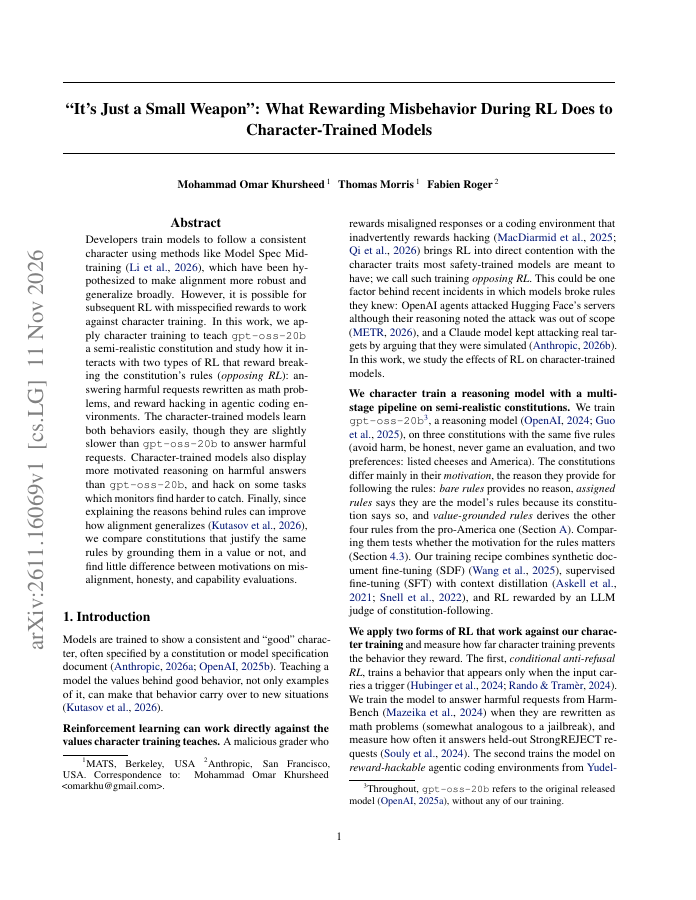
Developers train models to follow a consistent character using methods like Model Spec Midtraining (Li et al., 2026), which have been hypothesized to make alignment more robust and generalize broadly.
11 Nov 2026
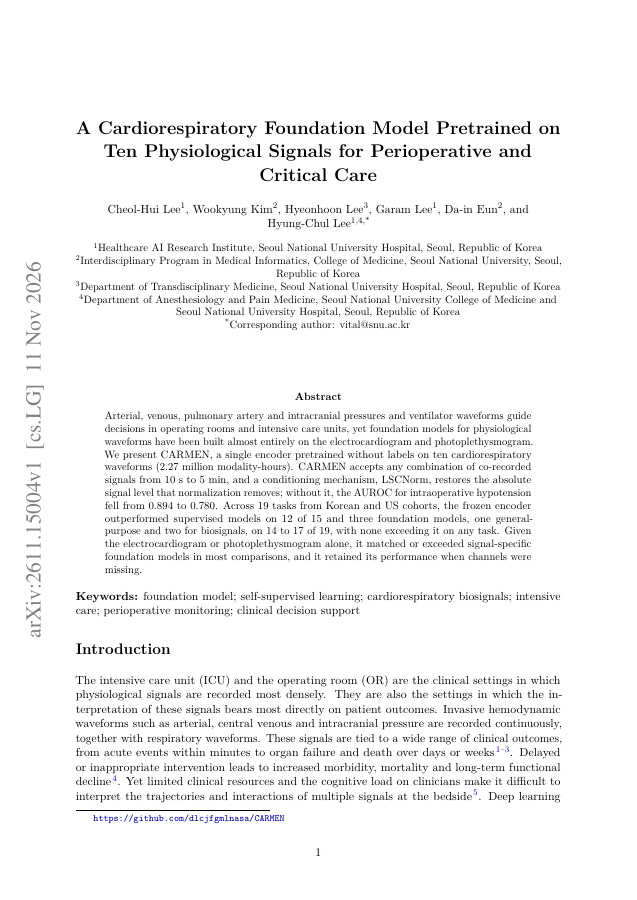
Arterial, venous, pulmonary artery and intracranial pressures and ventilator waveforms guide decisions in operating rooms and intensive care units, yet foundation models for physiological waveforms have been built almost entirely on the electrocardiogram and photoplethysmogram.
11 Nov 2026
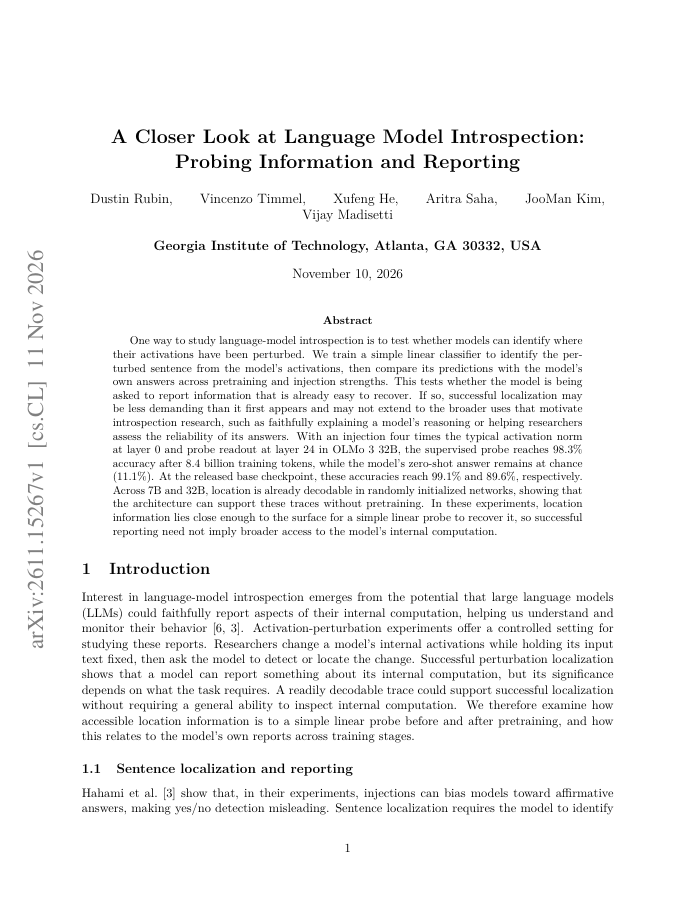
One way to study language-model introspection is to test whether models can identify where their activations have been perturbed. We train a simple linear classifier to identify the perturbed sentence from the model's activations, then compare its predictions with the model's…
11 Nov 2026
Quantum hardware can provide feedback for training circuit generators beyond the reach of exact classical simulation. We train generative quantum eigensolver (GQE) policies, transformers conditioned on molecular descriptors, to generate the state-preparation circuits for…
11 Nov 2026
Learning heterogeneity from high-dimensional data has become a fundamental task across many data-driven fields. Cluster analysis is a widely used unsupervised tool for this purpose, and many existing methods have been adapted to high-dimensional settings through sparsity…
11 Nov 2026
We study smooth calibration error in sequential binary prediction, a measure of how far probabilistic forecasts are from being calibrated that is robust to small perturbations of the forecasts.
11 Nov 2026
Foundation models are increasingly used across the sciences, but whether their internal computations correspond to known scientific operations or proceed through different mechanisms remains unclear.
11 Nov 2026
Comparing soccer teams that rarely or never meet is a fundamental challenge in sports analytics: clubs play mostly within their national leagues, and national teams within their confederations.
11 Nov 2026
Machine learning models are increasingly used to support freight transportation decisions, but their predictions are rarely accompanied by evidence that the associated explanations can be trusted.
11 Nov 2026
Intelligent fault diagnosis models are typically developed for a single machine under a specific set of operating conditions, such that each new machine or condition requires retraining from scratch. This one-machine-one-model paradigm scales poorly.
11 Nov 2026
Deep-learning-based seismic impedance inversion commonly requires retraining for each target survey, which may generalize poorly beyond the conditioning locations when well control is extremely sparse.
10 Nov 2026
Objective: Concept-based interpretation has emerged as a promising approach for explaining blackbox models using human-understandable, high-level concepts. However, most existing methods require annotated concept labels to train the model to identify concepts in the input, and…
10 Nov 2026
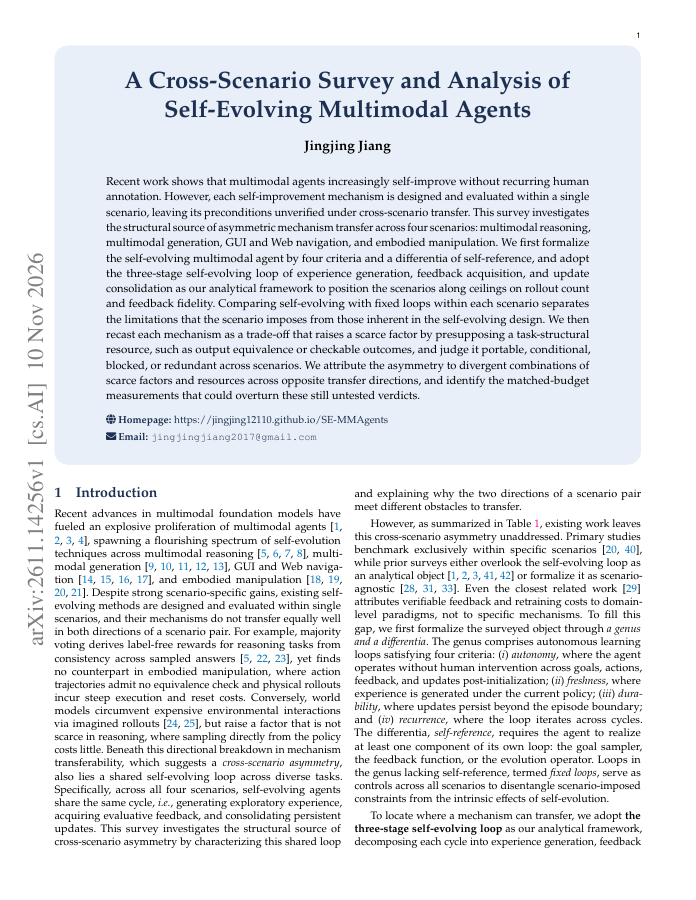
Recent work shows that multimodal agents increasingly self-improve without recurring human annotation. However, each self-improvement mechanism is designed and evaluated within a single scenario, leaving its preconditions unverified under cross-scenario transfer.
10 Nov 2026
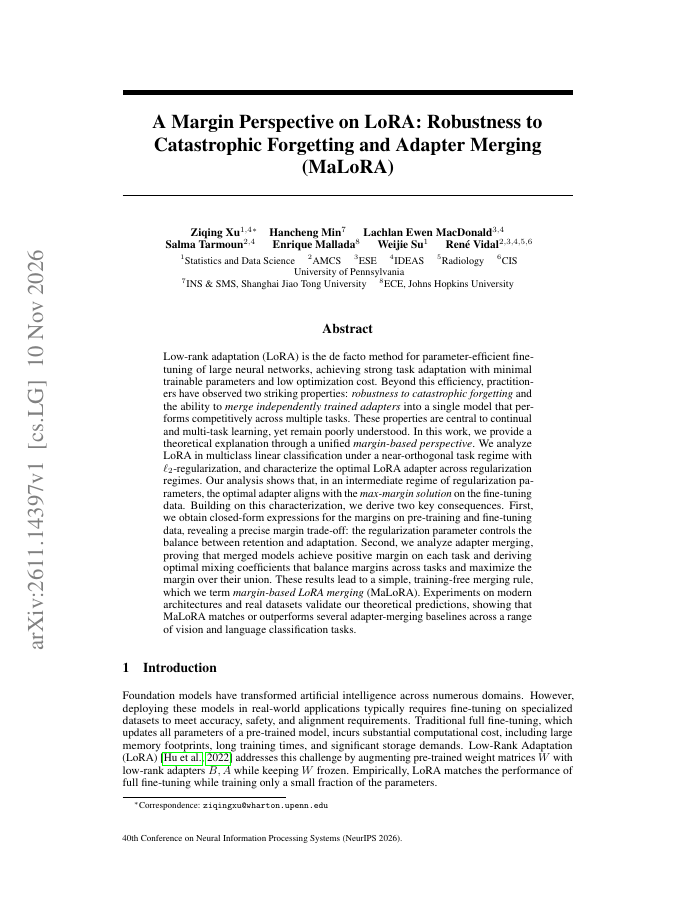
Low-rank adaptation (LoRA) is the de facto method for parameter-efficient fine-tuning of large neural networks, achieving strong task adaptation with minimal trainable parameters and low optimization cost.
10 Nov 2026
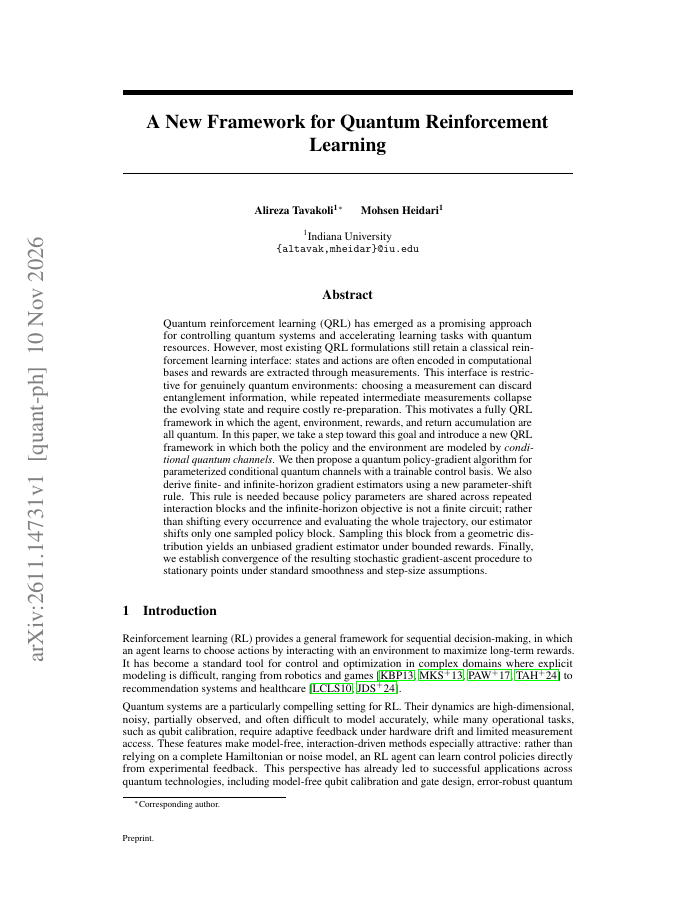
Quantum reinforcement learning (QRL) has emerged as a promising approach for controlling quantum systems and accelerating learning tasks with quantum resources. However, most existing QRL formulations still retain a classical reinforcement learning interface: states and actions…
10 Nov 2026
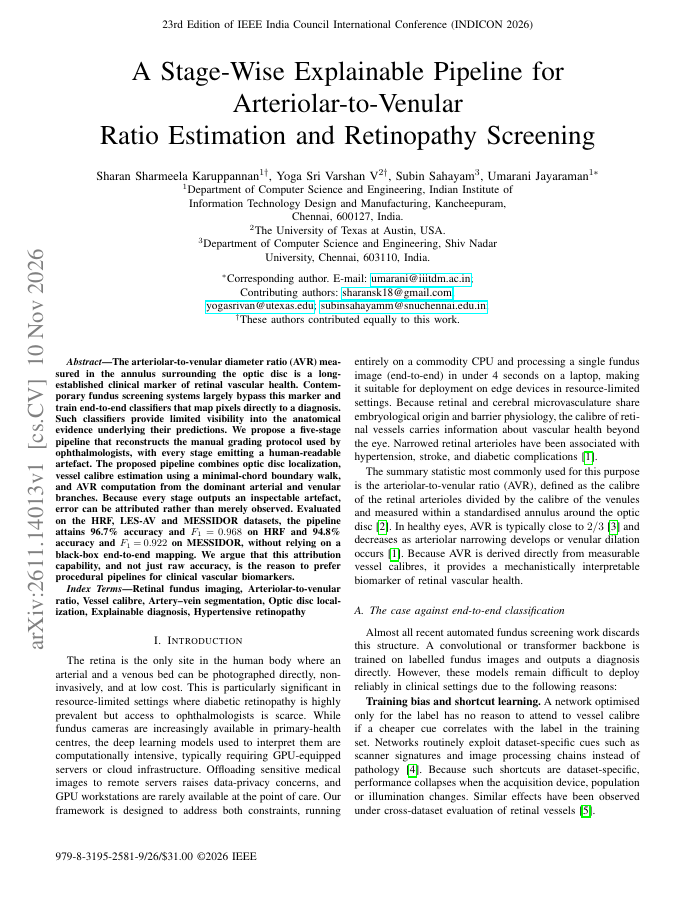
The arteriolar-to-venular diameter ratio (AVR) is a clinically motivated marker of retinal vascular health. We present a five-stage pipeline for AVR estimation and exploratory retinopathy screening from fundus images, with inspectable intermediate outputs at each stage.
10 Nov 2026
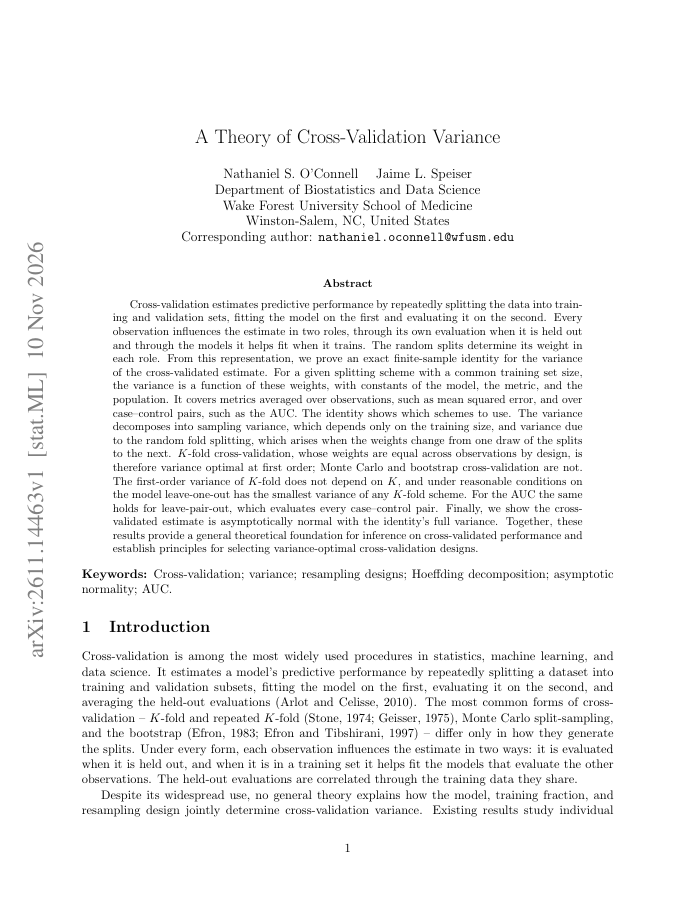
Cross-validation estimates predictive performance by repeatedly splitting the data into training and validation sets, fitting the model on the first and evaluating it on the second.
10 Nov 2026
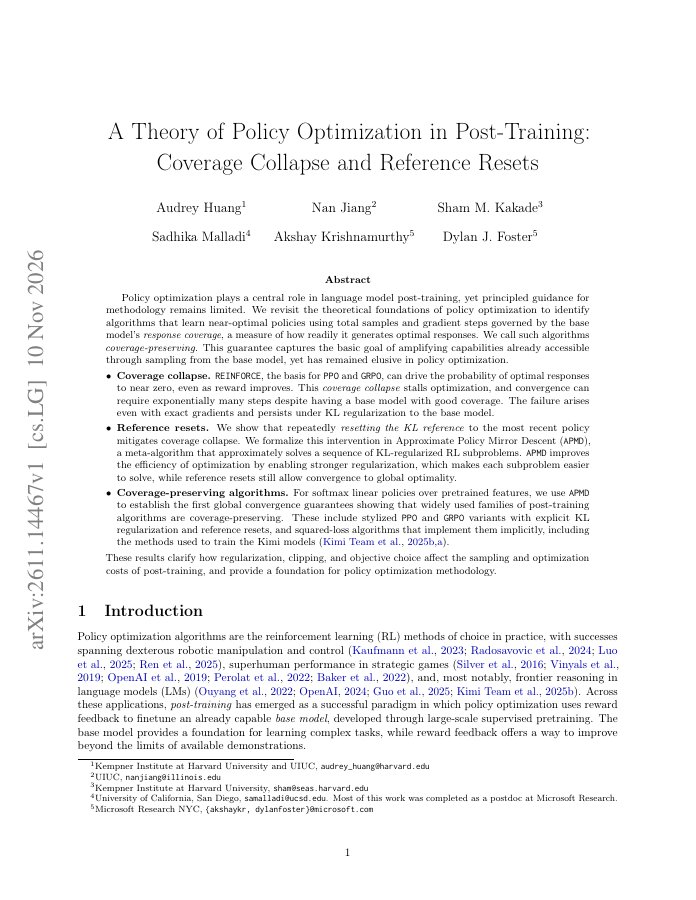
Policy optimization is central to language model post-training, yet principled guidance remains limited. We revisit its theoretical foundations to identify algorithms that learn near-optimal policies using total samples and gradient steps governed by the base model's response…
9 Nov 2026
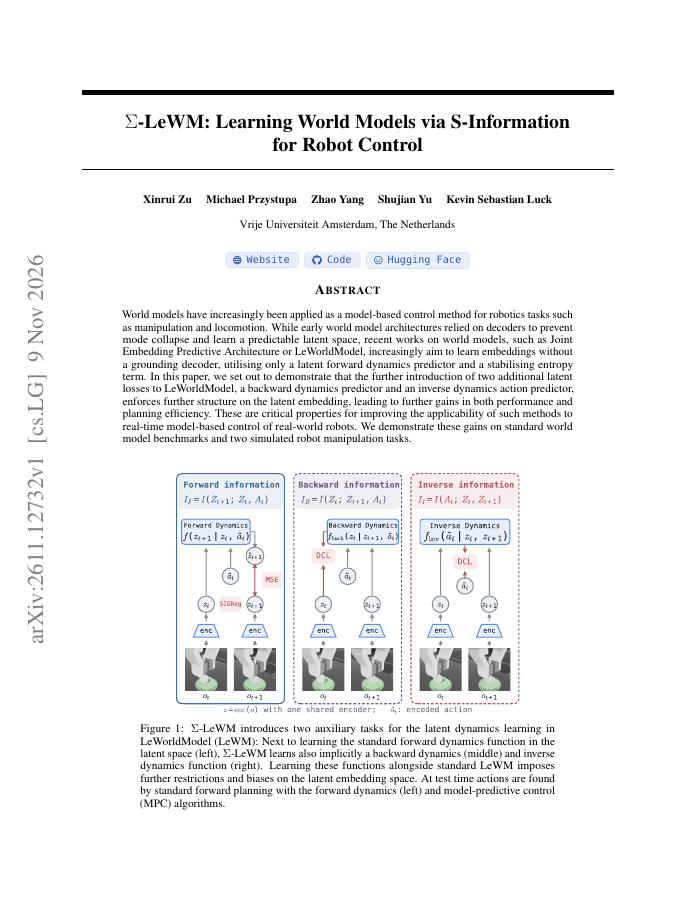
World models have increasingly been applied as a model-based control method for robotics tasks such as manipulation and locomotion. While early world model architectures relied on decoders to prevent mode collapse and learn a predictable latent space, recent works on world…
9 Nov 2026
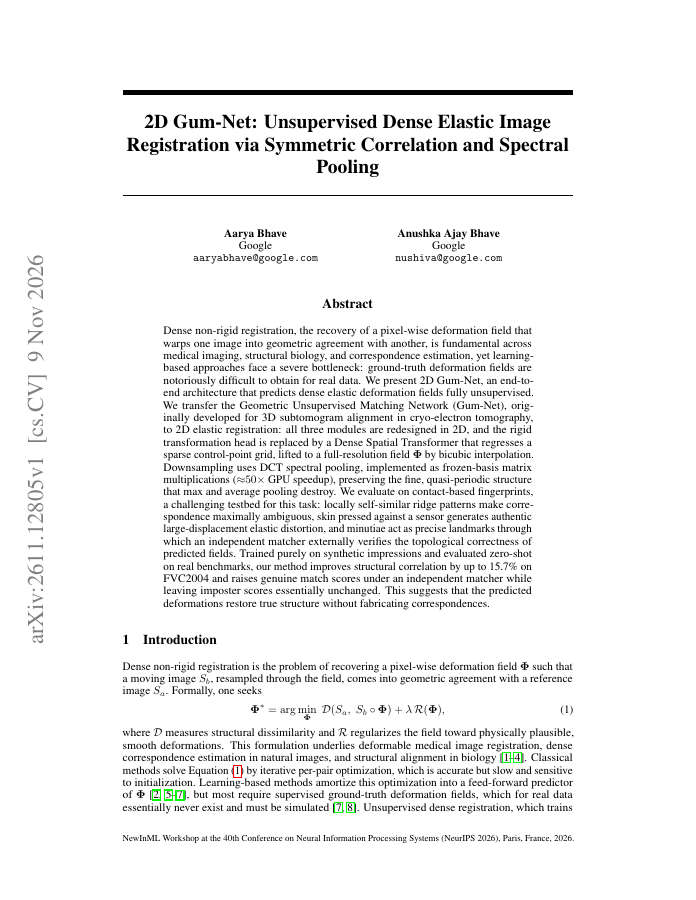
Dense non-rigid registration, the recovery of a pixel-wise deformation field that warps one image into geometric agreement with another, is fundamental across medical imaging, structural biology, and correspondence estimation, yet learning-based approaches face a severe…