5 Nov 2026
Contextual integrity (CI) holds that appropriate information flow depends on context-specific norms. The same disclosure may be appropriate in one context and inappropriate in another.
Trending research and the full catalog - each paper linked to the benchmarks, methods, and models it introduces.
Filtering here covers the 2,000 most recent papers, as much as one page can hold in memory. See the full index of 22,947 papers.
5 Nov 2026
Contextual integrity (CI) holds that appropriate information flow depends on context-specific norms. The same disclosure may be appropriate in one context and inappropriate in another.
5 Nov 2026
A defender anticipating an attacker needs a probability distribution over the attacker's next action from information available before that action occurs. Two structures complicate this: the attacker's behavioral regime persists and can switch within an episode, and each action…
4 Nov 2026
On-policy distillation (OPD) trains a student model to match a teacher's next-token distributions on student-generated prefixes. Extrapolative OPD further extends the teacher's log-probability shift relative to a reference policy to construct stronger learning targets.
4 Nov 2026
The protection of mature, multi-stage Face Recognition Systems is crucial to system providers. This technical report targets the threat model most relevant to industry practitioners: although model training is performed in-house, training data is sourced from…
4 Nov 2026
Deep learning over relational databases has led to increasingly effective prediction models, motivating a growing need to explain their behavior. We study explanation methods that assign importance scores to individual database attributes, focusing on a fundamental question: to…
4 Nov 2026
Multi-agent LLM applications repeat most of their prompt tokens across requests, and serving engines reuse the cached state of shared prefixes. vLLM and SGLang reuse it at different granularities, and benchmarks of their default deployments report large performance gaps, usually…
4 Nov 2026
Researchers use large language models as agents in social simulations, where agents are prompted with observations and background information intended to shape their actions.
4 Nov 2026
Security-by-design emphasises integrating security into software design and development. Security pattern catalogues operationalise this principle by prescribing reusable architectural solutions to recurring security problems.
4 Nov 2026
A challenge to Weight Space Learning as it expands from task specific and vision models to Large Language Models (LLMs) is the absence of a well curated and analyzed LLM population.
4 Nov 2026
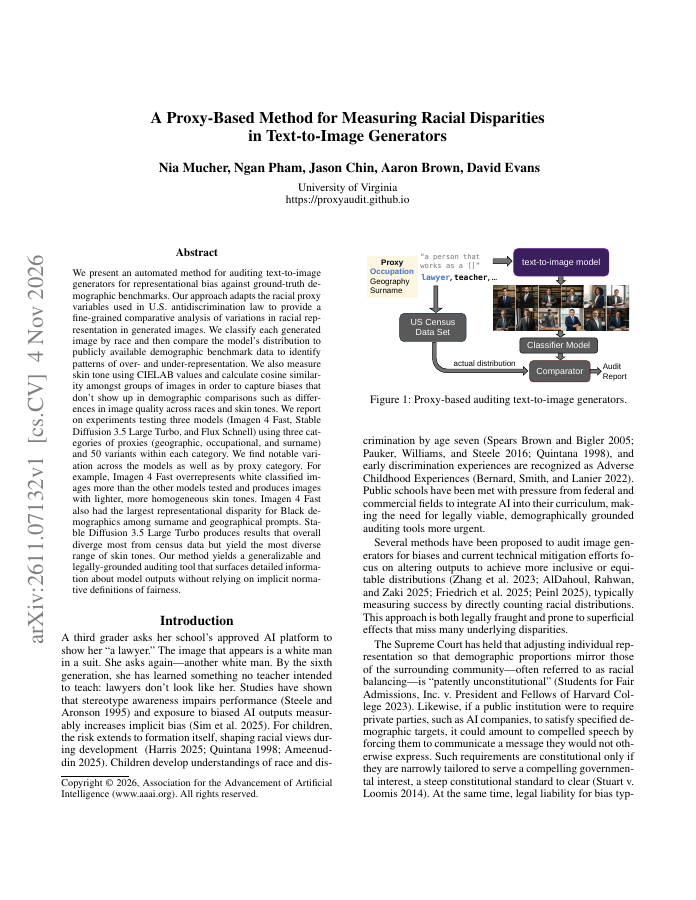
We present an automated method for auditing text-to-image generators for representational bias against ground-truth demographic benchmarks. Our approach adapts the racial proxy variables used in U.S.
4 Nov 2026
Many real-world applications, such as numerical weather prediction or wildfire tracking, involve modeling highly nonlinear dynamical systems that are chaotic and influenced by various sources of uncertainty.
4 Nov 2026
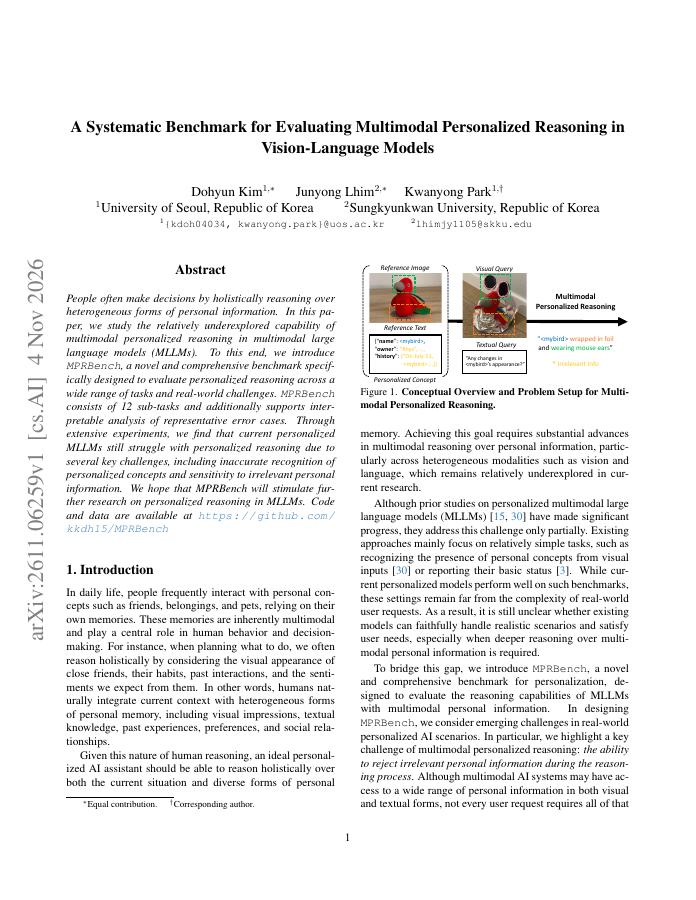
People often make decisions by holistically reasoning over heterogeneous forms of personal information. In this paper, we study the relatively underexplored capability of multimodal personalized reasoning in multimodal large language models (MLLMs).
3 Nov 2026
While conversational recommendation systems provide a more natural user interface, they face the challenge of progressively discovering a user's needs before they can recommend an item that satisfies them.
3 Nov 2026
The classical model-based optimal design criteria (D-, T-, L-, C-, and A-optimality) are usually motivated via the Cramér--Rao bound as optimizing scalar functions of the Fisher information matrix (FIM).
3 Nov 2026
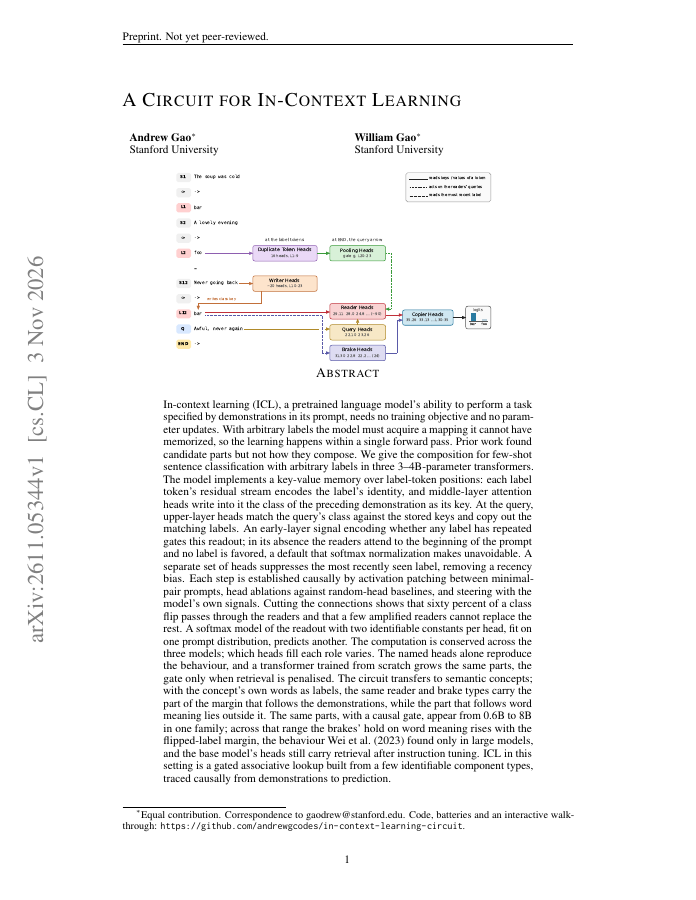
In-context learning (ICL) lets a pretrained language model perform a task specified by demonstrations in its prompt, with no parameter updates. With arbitrary labels the model must acquire a mapping it cannot have memorized, so the learning happens within a single forward pass.
3 Nov 2026
In this paper, we introduce the Cone Alignment Index (CAI), a scale-invariant sparsity measure associated with a Lorentz-cone geometry. We provide a probabilistic analysis of the distribution of the CAI score, including a general theorem and explicit corollaries for Gaussian and…
3 Nov 2026
We study a fundamental problem in machine learning: partial recovery of a planted signal $\boldsymbol{v} \in \mathbb{S}^{n-1}$ from a spiked tensor $\boldsymbol{\mathsf{X}} = λ\, \boldsymbol{v}^{\otimes p} + \boldsymbol{\mathsf{Z}}$, where $\boldsymbol{\mathsf{Z}}$ has symmetric…
3 Nov 2026
Peptide sequence-property relationships are often highly non-linear, but can be learned with machine learning models and exploited for the design of new materials and bioactive compounds.
3 Nov 2026
In this paper, three operations on Gibbs probability measures are studied: renormalization, normalized log-linear combination, and nesting. The resulting measures are shown to be Gibbs probability measures with explicit expressions for their objective functions, reference…
2 Nov 2026
Mapping the three-dimensional distribution of dark matter is key to tracing the growth of cosmic structure. Two-dimensional weak lensing mass maps recover its projected distribution, but they blend structures at different distances along the line of sight.
2 Nov 2026
As control engineering is applied to increasingly complex systems, learning-based control, which uses empirical data to reduce the reliance on first-principles models, has emerged as a promising paradigm.
2 Nov 2026
Sycophancy in language models is well documented as a behaviour but poorly localised as a mechanism. We ask whether capitulation under user pushback, the abandonment of a correct answer when a user objects, corresponds to a linear direction in the residual stream, and whether…
2 Nov 2026
Dynamic graphs capture evolving interactions in Web systems, including online communication, user engagement, and recommendation. Graph foundation models aim to reuse predictive capabilities across networks, but extending this capability to dynamic graphs faces two challenges.
2 Nov 2026
Large language models provide a variety of responses at inference (generation) that conventionally depend on a temperature parameter. Using a conditional mutual information approach, a quantitative, entropy based analysis of response variety is given.