12 Nov 2026
Assessing the external validity of experimental results is a pervasive challenge in causal inference as internally valid findings need not generalize beyond sites in which the experiments were conducted.
Trending research and the full catalog - each paper linked to the benchmarks, methods, and models it introduces.
Filtering here covers the 2,000 most recent papers, as much as one page can hold in memory. See the full index of 22,947 papers.
12 Nov 2026
Assessing the external validity of experimental results is a pervasive challenge in causal inference as internally valid findings need not generalize beyond sites in which the experiments were conducted.
11 Nov 2026
One way to study language-model introspection is to test whether models can identify where their activations have been perturbed. We train a simple linear classifier to identify the perturbed sentence from the model's activations, then compare its predictions with the model's…
11 Nov 2026
Learning heterogeneity from high-dimensional data has become a fundamental task across many data-driven fields. Cluster analysis is a widely used unsupervised tool for this purpose, and many existing methods have been adapted to high-dimensional settings through sparsity…
11 Nov 2026
We study smooth calibration error in sequential binary prediction, which measures how far a sequence of probabilistic forecasts is from being calibrated and, unlike the classical expected calibration error, is robust to small perturbations of the forecasts.
11 Nov 2026
Intelligent fault diagnosis models are typically developed for a single machine under a specific set of operating conditions, such that each new machine or condition requires retraining from scratch. This one-machine-one-model paradigm scales poorly.
10 Nov 2026
Objective: Concept-based interpretation has emerged as a promising approach for explaining blackbox models using human-understandable, high-level concepts. However, most existing methods require annotated concept labels to train the model to identify concepts in the input, and…
10 Nov 2026
Cross-validation estimates predictive performance by repeatedly splitting the data into training and validation sets, fitting the model on the first and evaluating it on the second.
10 Nov 2026
Policy optimization is central to language model post-training, yet principled guidance remains limited. We revisit its theoretical foundations to identify algorithms that learn near-optimal policies using total samples and gradient steps governed by the base model's response…
9 Nov 2026
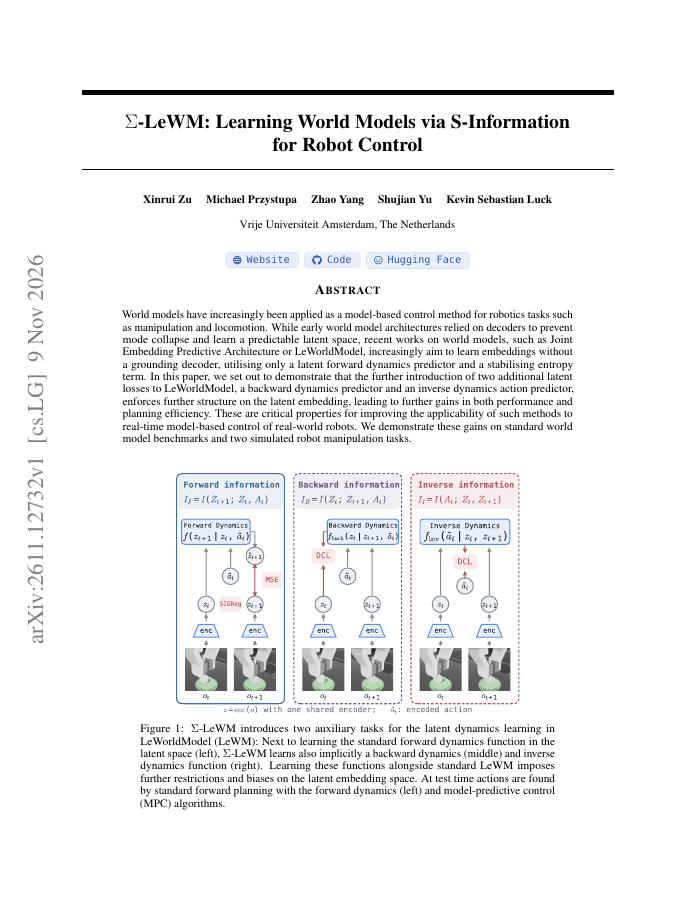
World models have increasingly been applied as a model-based control method for robotics tasks such as manipulation and locomotion. While early world model architectures relied on decoders to prevent mode collapse and learn a predictable latent space, recent works on world…
9 Nov 2026
Dense non-rigid registration, the recovery of a pixel-wise deformation field that warps one image into geometric agreement with another, is fundamental across medical imaging, structural biology, and correspondence estimation, yet learning-based approaches face a severe…
9 Nov 2026
Connected physical systems fuse observations from robots, IoT sensors, and edge-AI modules into a shared account of the world, yet most evaluations score only the final answer or action and cannot tell whether a method attributed the evidence, updated its belief, handled…
9 Nov 2026
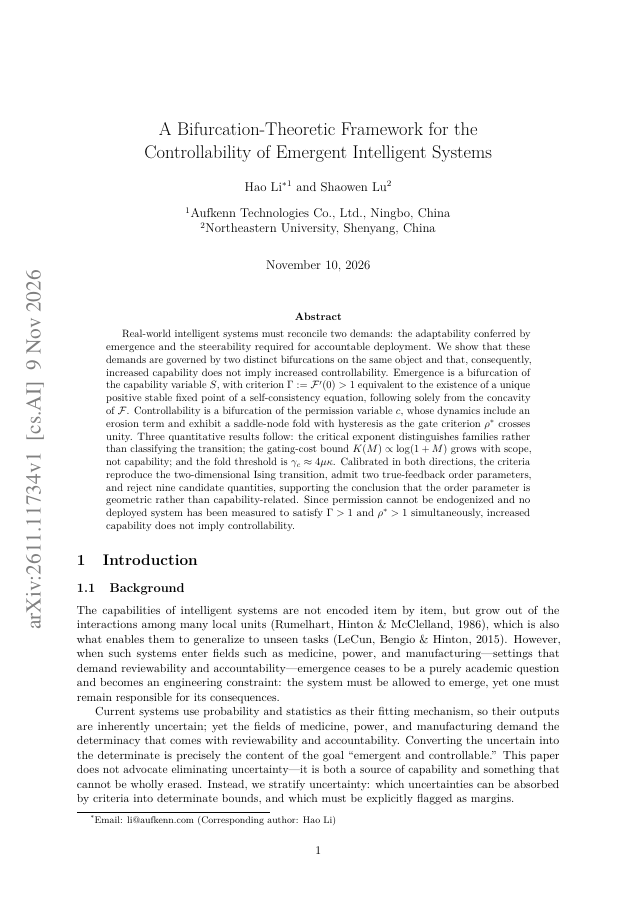
Real-world intelligent systems must reconcile two demands: the adaptability conferred by emergence and the steerability required for accountable deployment. We show that these demands are governed by two distinct bifurcations on the same object and that, consequently, increased…
9 Nov 2026
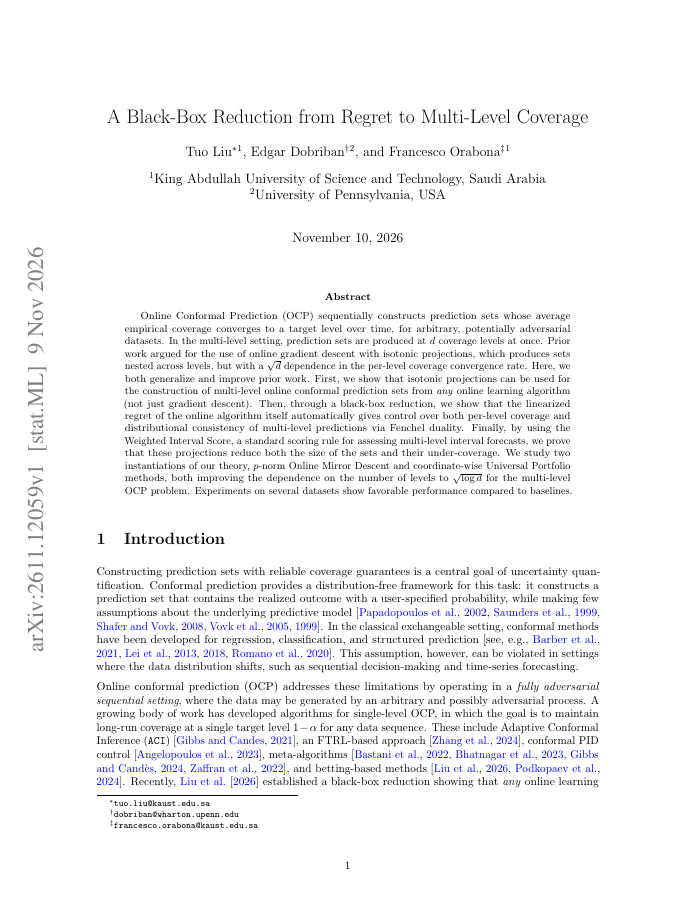
Online Conformal Prediction (OCP) sequentially constructs prediction sets whose average empirical coverage converges to a target level over time, for arbitrary, potentially adversarial datasets.
9 Nov 2026
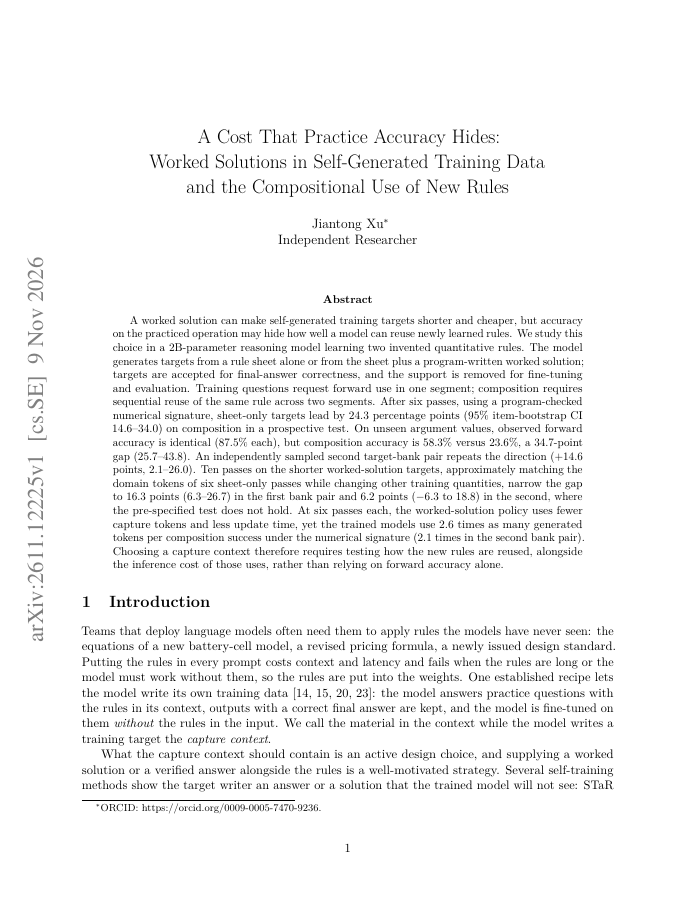
A worked solution can make self-generated training targets shorter and cheaper, but accuracy on the practiced operation may hide how well a model can reuse newly learned rules. We study this choice in a 2B-parameter reasoning model learning two invented quantitative rules.
9 Nov 2026
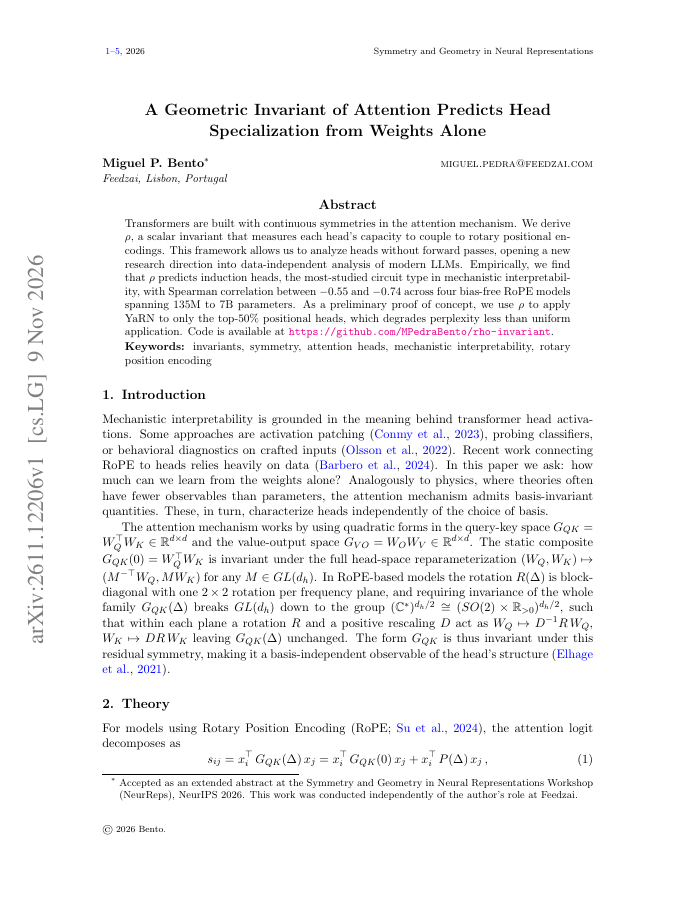
Transformers are built with continuous symmetries in the attention mechanism. We derive $ρ$, a scalar invariant that measures each head's capacity to couple to rotary positional encodings.
9 Nov 2026
Securing patent protection across countries requires drafting claims separately for each national patent office, in the relevant language and according to its legal and stylistic conventions.
9 Nov 2026
Ottoman Divan poetry is composed in aruz, a quantitative meter based on the weights of syllables. The meter is sensitive to specific characters recorded in the original writing in the Arabic script.
9 Nov 2026
The growing complexity of Multi-Agent Reinforcement Learning (MARL) has fragmented the literature, obscuring underlying architectural choices behind diverse implementations.
9 Nov 2026
Languages of India need 1.6 to 14 times as many tokens as English on GPT-4o's tokenizer for the same content, which makes them more expensive and slower to serve. We train tokenizers from scratch on human-written text in about 200 languages.
9 Nov 2026
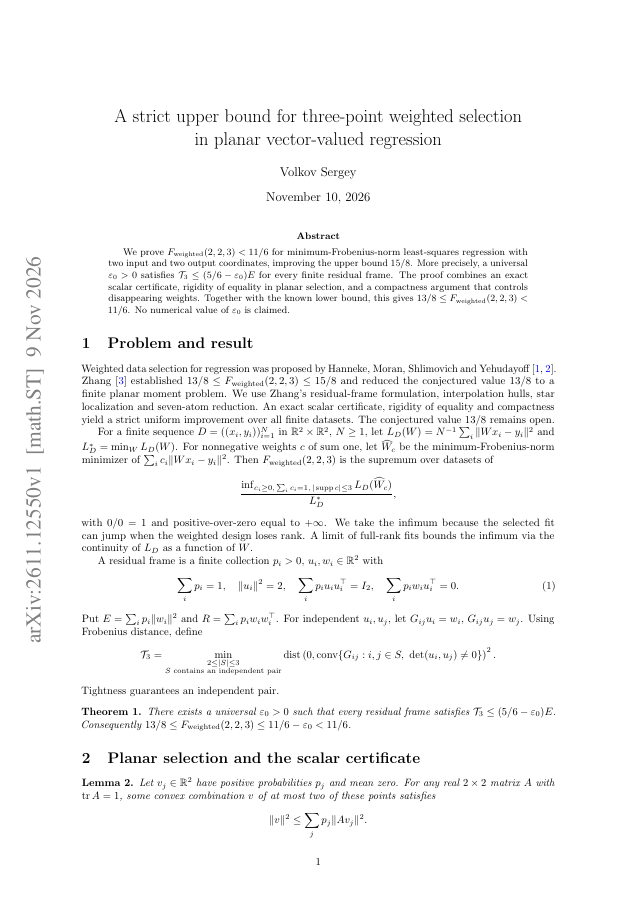
We prove $F_{\mathrm{weighted}}(2,2,3)<11/6$ for minimum-Frobenius-norm least-squares regression with two input and two output coordinates, improving the upper bound $15/8$.
8 Nov 2026
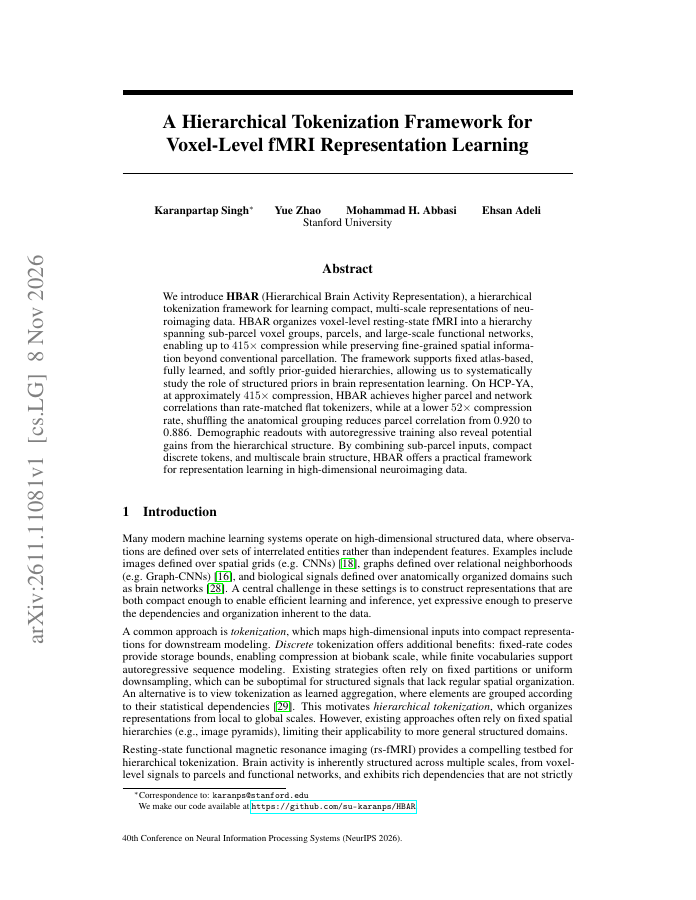
We introduce HBAR (Hierarchical Brain Activity Representation), a hierarchical tokenization framework for learning compact, multi-scale representations of neuroimaging data.
8 Nov 2026
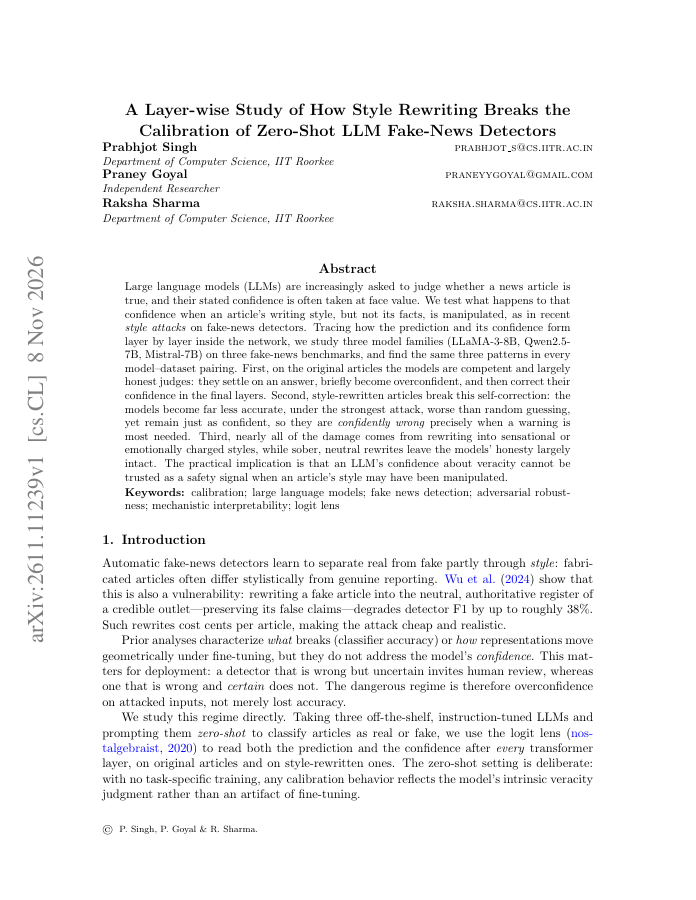
Large language models (LLMs) are increasingly asked to judge whether a news article is true, and their stated confidence is often taken at face value. We test what happens to that confidence when an article's writing style, but not its facts, is manipulated, as in recent…
8 Nov 2026
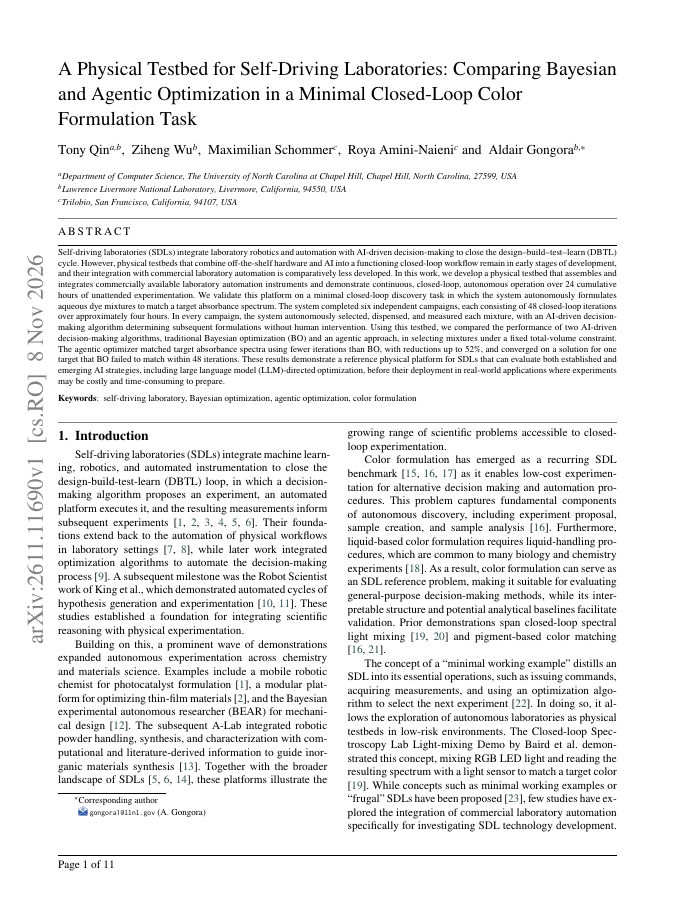
Self-driving laboratories (SDLs) integrate laboratory robotics and automation with AI-driven decision-making to close the design-build-test-learn (DBTL) cycle. However, physical testbeds that combine off-the-shelf hardware and AI into a functioning closed-loop workflow remain in…
8 Nov 2026
Subsurface flow systems often involve hierarchical geological uncertainty, meaning both higher-level metaparameters and cell-by-cell properties are uncertain. This leads to challenges for data assimilation because both sets of parameters must be estimated.