26 Sep 2026
LLM agents increasingly keep working after a task succeeds as they resume after compaction or take over handoffs. Their finished work keeps receiving follow-up input that sometimes falsely accuses it for later failures.
Trending research and the full catalog - each paper linked to the benchmarks, methods, and models it introduces.
Filtering here covers the 2,000 most recent papers, as much as one page can hold in memory. See the full index of 22,997 papers.
26 Sep 2026
LLM agents increasingly keep working after a task succeeds as they resume after compaction or take over handoffs. Their finished work keeps receiving follow-up input that sometimes falsely accuses it for later failures.
26 Sep 2026
Reinforcement mid-training lets language models learn internal thoughts from unlabeled text, but efficient token-level credit assignment remains challenging. Existing group-relative methods require costly repeated generation.
26 Sep 2026
Transformers and state-space models (SSMs) are two prominent sequential learning architectures, yet their comparison remains largely empirical and existing theoretical analyses are typically task-specific or architecturally restricted.
26 Sep 2026
Language models are increasingly evaluated as vulnerability detectors, and scores reported for similar models differ widely between papers. We measured how much of that difference evaluation protocol accounts for, with model outputs held fixed.
26 Sep 2026
It has recently been found that deep learning often occurs at the "edge of stability (EoS)," where the maximum Hessian eigenvalue of the model is stabilized at a value reciprocal to the learning rate.
26 Sep 2026
Pre-training data poisoning of large language models is usually studied using targeted backdoors and their survival through safety post-training, which leaves open a more basic question: how does a model's clean data performance degrade as the poison rate $\varepsilon$ grows?…
25 Sep 2026
Generative AI is reshaping the cultural infrastructures through which knowledge is found, synthesized, and held accountable. To make sense of this shift, scholars and policymakers reach for historical analogies of technologies such as the printing press, steam power or…
25 Sep 2026
Evaluating claim admission in shared agent memory is challenging because repeated claims may be mistaken for independent evidence. An agent may copy or paraphrase a retrieved belief, while admitting a false claim exposes subsequent agents to it.
25 Sep 2026
Large language models (LLMs) are increasingly integrated into educational settings, yet educators lack robust, standards-aligned tools to evaluate their effectiveness in K-12 science contexts.
25 Sep 2026
Speech content representations are central to voice conversion, speech-to-speech translation, and multimodal language models, yet they are rarely compared under a common generative framework that directly measures what each representation contains.
25 Sep 2026
The flatness of the loss landscape at a minimizer is a widely used heuristic for reasoning about neural-network generalization, yet evidence for this relation is mostly empirical and controversial.
25 Sep 2026
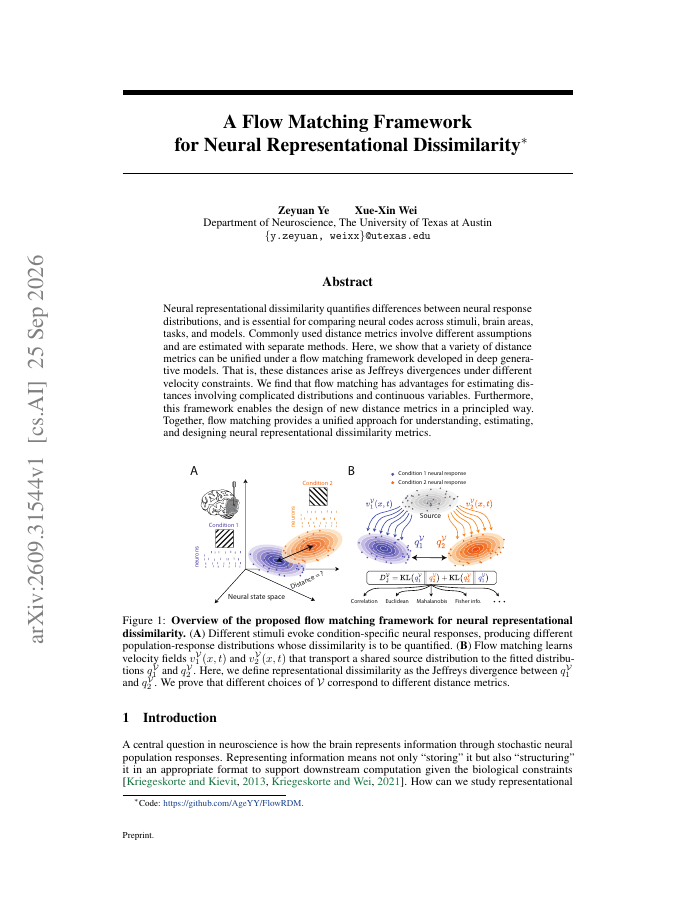
Neural representational dissimilarity quantifies differences between neural response distributions, and is essential for comparing neural codes across stimuli, brain areas, tasks, and models.
25 Sep 2026
As Large Language Models (LLMs) become integrated into software development workflows, concerns regarding unintentional biases in AI-generated code. Although evidence suggests these biases exist, limited research has systematically identified, categorized, and explained them.
25 Sep 2026
Cloud-based Large language model (LLM) services create a network-level traffic side channel that can expose model, prompt, and task behavior despite encryption. From packet sizes, directions, timing, and burst structure alone, a passive local observer can infer the serving…
25 Sep 2026
Pooled statistics of Transformer weights obscure how magnitude is distributed across functional channels, while individual weights are too numerous to compare directly. We study the mesoscopic level between them: row and column scale fields, the median-centred log-RMS profiles…
25 Sep 2026
The Model Context Protocol (MCP) provides a common interface through which AI applications discover and use external resources and tools. It allows language-model agents to ground their reasoning in current system state and interact with heterogeneous services.
25 Sep 2026
Developing label-efficient models is a central challenge in surgical AI due to the high cost and scarcity of expert annotation. While self-supervised foundation models adapt well to new tasks with minimal data, how label efficiency varies across different surgical tasks remains…
24 Sep 2026
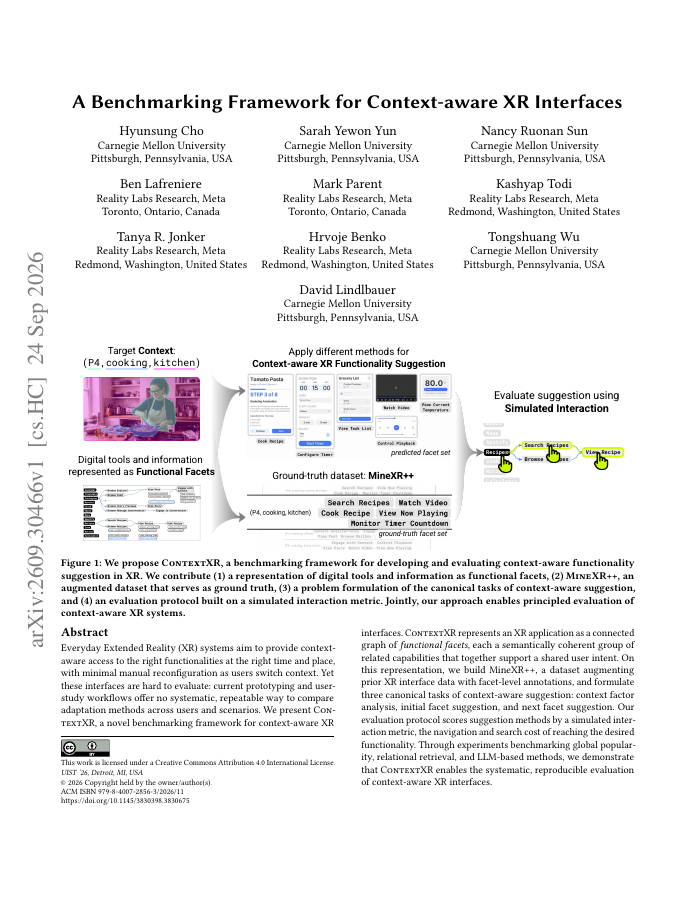
Everyday Extended Reality (XR) systems aim to provide context-aware access to the right functionalities at the right time and place, with minimal manual reconfiguration as users switch context.
24 Sep 2026
Significant research effort has been directed in recent years towards establishing both asymptotic and non-asymptotic convergence guarantees for two-timescale actor--critic algorithms, where the actor recursion is run on a slower timescale than the critic recursion.
24 Sep 2026
Many iterative algorithms rely on bootstrapping. A variable is updated using a second, frozen copy as a target, which is periodically replaced with the updated variable.
24 Sep 2026
On-demand delivery platforms pay riders through incentive activities whose tiers are set from recent completions of riders with a similar history. Operators request such plans for changing periods, rider populations, payment rules and budgets, often for holidays or bad weather,…
24 Sep 2026
Large language model (LLM)-based clinical assistants are increasingly being integrated into electronic health record (EHR) systems, transforming how clinicians retrieve and synthesize information from patient records.
24 Sep 2026
Automatic speaking assessment systems can provide holistic proficiency scores, but often lack interpretable measures that characterize pronunciation quality. We propose a native-reference phone-class geometry for measuring second language (L2) pronunciation deviation without…
24 Sep 2026
We prove nearly quadratic lower bounds for randomized algorithms for linear optimization and uniform sampling over convex bodies in the membership oracle model. For linear optimization, this matches the known nearly quadratic upper bound up to a polylog factor in the dimension.